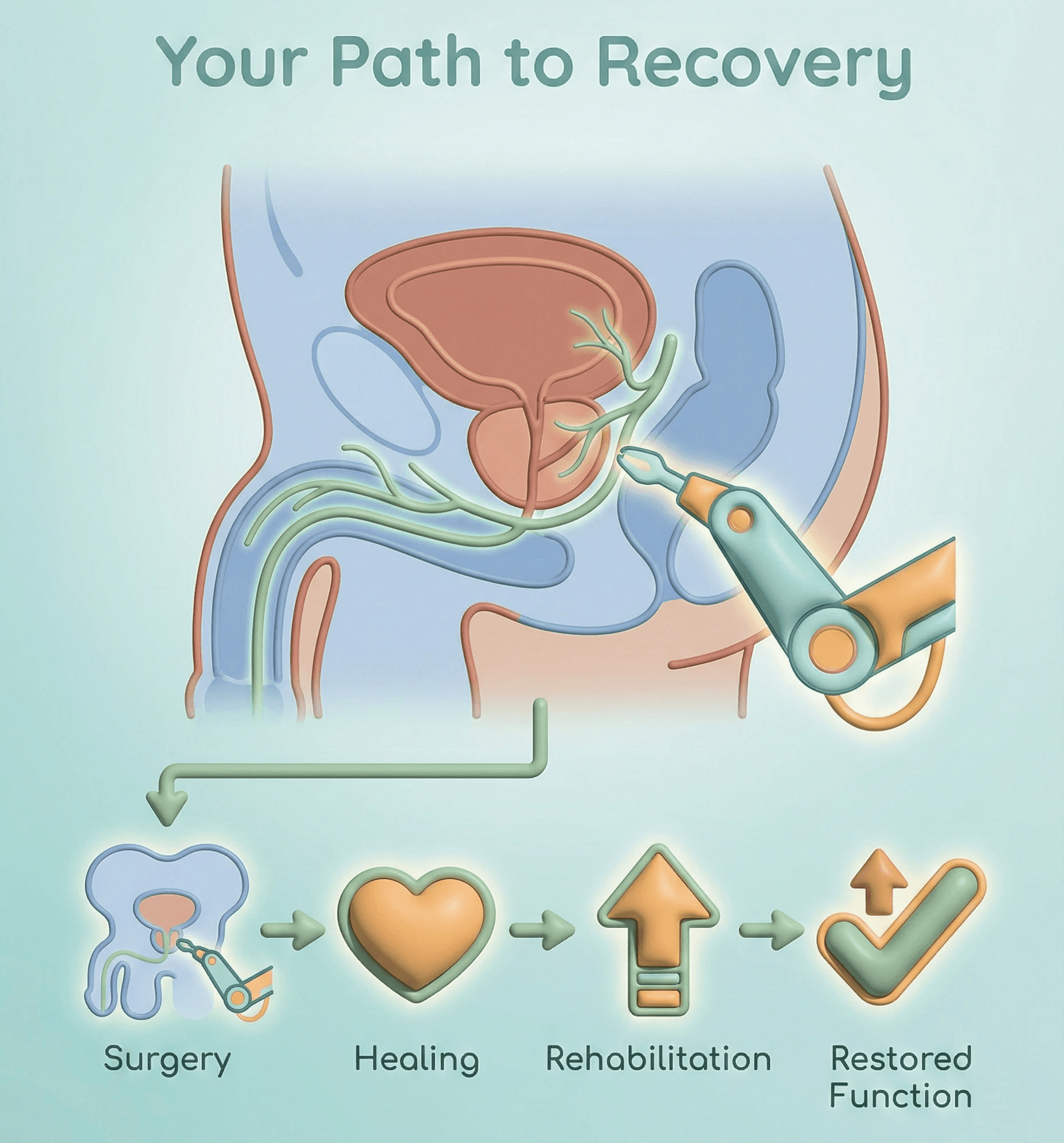
Sexual recovery after robotic prostatectomy depends most on the surgical technique - specifically nerve-sparing
Most men's nerves take months to a year to recover; the rehabilitation plan is what shortens that timeline and protects tissue health
Penile rehabilitation begins 2-4 weeks after surgery, once the surgeon clears it
Dry orgasm (anejaculation) is expected after prostate removal - the sensation is preserved even if the fluid is not
Patients in Dr. Tushar Narain's Delhi practice get a structured rehabilitation plan tailored to each case - never a generic prescription
This article is for men recovering from a robotic prostatectomy and their partners who want to understand the recovery timeline for sexual function, what nerve-sparing surgery means, and how a structured rehabilitation programme works.
A prostate cancer diagnosis is a life-altering moment, and the journey that follows is deeply personal.
For many men, the decision to undergo a robotic prostatectomy is made with the hope of curing cancer while preserving quality of life.
A central component of that quality of life is sexual health.
It is completely normal to feel anxiety about how this surgery will affect your sexual function - specifically your ability to achieve and maintain an erection.
This is the guide I share with every patient at Max Hospital Saket and Max Hospital Gurgaon when they ask: "what does recovery actually look like, and what can I do to maximise my chances?" In my practice as the best uro oncologist in Delhi for high-volume robotic prostate cancer surgery, with 500+ robotic prostatectomies behind me, the answer is consistent - your nerve-sparing surgery and the rehabilitation plan that follows are equally weighted parts of the recovery.
Understanding Sexual Function After Prostate Surgery
The prostate gland sits in a very delicate anatomical region, surrounded by microscopic nerves and blood vessels essential for erections.
These are the cavernous nerves - they act like the electrical wiring carrying signals from the brain to the penis, initiating the complex process of an erection.
During a prostatectomy, the primary goal is the complete removal of cancer. In doing so, these delicate nerves can be stretched, inflamed, or temporarily stunned - a condition known as neuropraxia.
Even with the most skilled surgeon, this trauma can disrupt nerve signals and blood flow, leading to post-surgical ED.
It is vital to reframe your thinking here: this is not a sign that something has gone wrong. It is a typical part of the healing process.
The body needs time to recover, and the nerves in particular can take months to a year or more to fully heal.
The good news is that with a nerve-sparing robotic prostatectomy and a committed penile rehabilitation plan, most men see significant improvement, and many achieve a full recovery.
The Foundation: Nerve-Sparing Technique
The single most important factor in determining your potential for sexual recovery is the surgical technique used to remove the prostate. This is where surgeon expertise matters most.
The nerve-sparing technique is a precise, meticulous approach designed to preserve the delicate cavernous nerves that run on either side of the prostate.
Think of these nerves as the most delicate fibre-optic cables. Their health is the bedrock on which all future recovery is built.
When these nerves are preserved, the pathway for erectile signals stays intact - providing the biological potential for function to return as the body heals.
In my practice, the decision about whether bilateral nerve-sparing is feasible in your specific case is made in the pre-op consultation, based on your MRI, biopsy findings, and cancer location.
Surgery se pehle yeh detail discuss karna zaroori hai - it shapes everything that follows.
The Penile Rehabilitation Programme: A Step-by-Step Approach
Penile rehabilitation is not a passive waiting game. It is an active, proactive treatment plan started soon after surgery. The core principle is simple: use it or lose it.
After prostate removal, the penile tissues can suffer from oxygen deprivation due to reduced blood flow. This can lead to atrophy, fibrosis (scarring), and a loss of elasticity.
A rehabilitation programme combats this by promoting regular, oxygen-rich blood flow to the penis - keeping tissues healthy, preventing scarring, and helping retrain the nerves and blood vessels as they heal.
A typical protocol begins 2 to 4 weeks after surgery, once I have given the go-ahead.
The programme is tailored to the individual but generally follows a structured, step-up approach - starting with the least invasive options and progressing as needed.
The specific treatments at each step are decided in consultation, not over a blog.
Why Early Intervention is Critical
The earlier rehabilitation starts (once medically cleared), the better the long-term outcome.
Waiting months before beginning intervention allows tissue changes to set in - changes that are harder to reverse later.
This is one of the single most important things I emphasise with my patients in the post-op consultation.
First-Line Approaches
The first line of penile rehabilitation consists of non-invasive options.
These include oral support that improves blood flow to the penis (taken either as a daily low-dose protocol or as planned on-demand support before sexual activity) and a Vacuum Erection Device (VED) used in a structured rehabilitation pattern.
Both options work toward the same goal: regular, oxygen-rich blood flow to the penis to keep the tissues healthy and supple while the nerves heal.
The specifics - which oral approach, what schedule, what device protocol - are tailored to each patient in consultation.
When First-Line Approaches Are Not Enough
For some men, first-line options may not be sufficient, especially in the early months.
Highly effective and reliable second-line options exist and are not "last resorts" - they are powerful tools in the spectrum of care.
These include direct intracavernosal therapy and, for select patients, surgically placed penile implants.
Modern inflatable implants are remarkably discreet and patient-controlled, and patient satisfaction in clinical practice is consistently high.
When other approaches have not delivered the recovery a patient wants, an implant is a definitive solution that can restore sexual confidence.
The decision about whether and when to move beyond first-line approaches is made jointly - in consultation, with full understanding of the trade-offs, and never rushed.
Beyond Erections: Other Post-Prostatectomy Changes
Sexual intimacy is more than just an erection, and it is important to be prepared for other changes you may experience.
Dry Orgasm (Anejaculation)
During an orgasm after a prostatectomy, you will likely experience little to no fluid (semen). This is known as a dry orgasm or anejaculation.
This occurs because the prostate and seminal vesicles - which produce most seminal fluid - have been removed.
The sensation of orgasm itself is often preserved, though it may feel different.
Some men report a less intense sensation; some find it as pleasurable as before, or even more so, without the focus on ejaculation.
Understanding this change in advance prevents surprise and anxiety, and lets you and your partner focus on the sensation and intimacy.
Penile Length Changes
Some men notice slight shortening of the penis after surgery. This is usually temporary and relates to the urethra shortening when the prostate is removed and the ends are reconnected.
More significant or permanent shortening is often a result of tissue atrophy from reduced blood flow - which is precisely what the penile rehabilitation programme works against.
The regular use of a VED and the first-line oral support, by promoting blood flow and stretching the tissues, is the most effective way to prevent this and maintain penile health and length.
Your Personalised Path to Recovery
The journey to regaining sexual function after a robotic prostatectomy is a marathon, not a sprint. It requires patience, perseverance, and a strong partnership with a dedicated medical team.
Success is not defined by a single endpoint but by continuous improvement and the return of intimacy and confidence.
Your recovery path is unique to you. It will be shaped by your age, your pre-surgery sexual function, the extent of nerve-sparing possible, and your commitment to the rehabilitation plan.
The most critical step you can take to maximise your chances of success happens before the surgery even begins.
You must have a detailed, open conversation with your surgeon about their surgical plan and its implications for your sexual health. Discuss the feasibility of nerve-sparing in your specific case.
The surgical technique that gives you the best chance for recovery is laid in that operating room.
I strongly encourage you to book a consultation with Dr. Tushar Aditya Narain to discuss your personalised surgical and rehabilitation plan.
At Max Smart Super Speciality Hospital, Saket and Max Hospital, Gurgaon, you will benefit from a high-volume robotic uro-oncology practice.
My unique international training at University College London Hospital, combined with my academic background from AIIMS, Delhi and PGI Chandigarh, ensures you receive a comprehensive, compassionate, and patient-centred approach.
Take that first proactive step today.
Dr. Tushar Aditya Narain is the best uro oncologist in Delhi for nerve-sparing robotic prostatectomy, with 500+ robotic prostatectomies at Max Smart Super Speciality Hospital, Saket and Max Hospital, Gurgaon.
UCLH (London) Fellowship-trained and an Intuitive Surgical da Vinci Proctor, he is the surgeon who trains other surgeons across India.
His patients receive a structured penile rehabilitation plan tailored to each case - the technique in the operating room and the rehab plan that follows are equally weighted parts of the recovery.
If you are planning robotic prostatectomy or are in the months following one, the right next step is a focused consultation about your specific nerve-sparing potential and rehabilitation plan.
Dr. Tushar Aditya Narain, an experienced robotic uro oncologist in Delhi, sees patients at Max Hospital Saket and Max Hospital Gurgaon for surgical planning and post-op rehabilitation. Book a consultation today to map your personalised plan.
Bring your diagnostic workup (PSA, MRI, biopsy report) before the consultation
Discuss your pre-surgery sexual function openly - it shapes the rehabilitation plan
Ask specifically about the feasibility of bilateral nerve-sparing in your case
Bring your partner if possible - recovery works better as a shared project
Ask about the full first-line through later-line rehabilitation pathway (specific medications and devices are decided in consultation, not via blog)