Robotic Surgery for Penile Cancer

Penile cancer treatment including organ-preserving surgery and robotic R-VEIL dissection. Confidential consultations at Max Hospital Delhi.
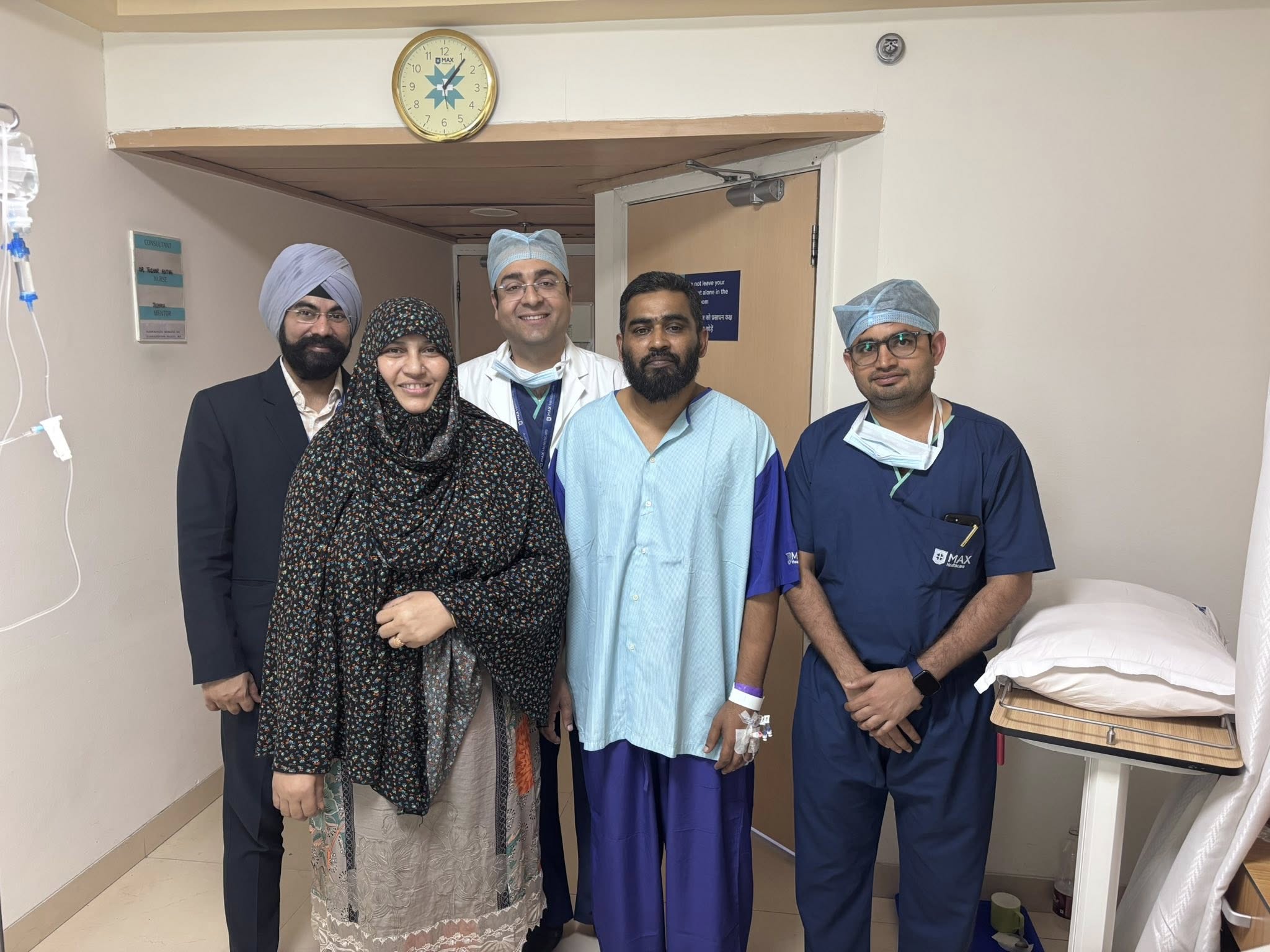
Expert penile cancer treatment team led by Dr. Tushar Aditya Narain at Max Hospital, providing comprehensive post-operative care for a recovering patient.

Facing Diagnosis: Why Early Action Saves More Than Just Life.


Penile cancer is rare, often presenting as a lump or ulcer on the foreskin or glans. Many patients delay seeking care due to shame, fear, or denial. The excellent news is that cure rates exceed 95% for early disease. However, diagnosis must be immediate, as delays compromise the chance of preserving the organ. Biopsy is mandatory to confirm the diagnosis and determine the risk of spread to the lymph nodes.

The Robotic Edge: Minimally Invasive Staging (R-VEIL).


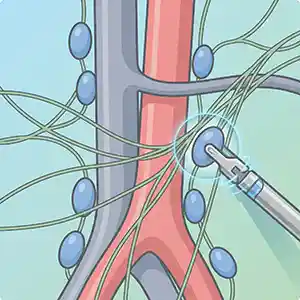
For early tumors, treatment focuses on organ-preserving surgery (e.g., local excision or glans resurfacing). Because lymph node status dictates survival, precise staging is critical. We specialize in Robotic Video Endoscopic Inguinal Lymph Node Dissection (R-VEIL), an advanced, minimally invasive technique used to dissect and remove the inguinal lymph nodes. R-VEIL offers significantly reduced complications, notably avoiding the severe lymphedema that disables patients after traditional open groin dissection.

Restoring Identity and Function: Beyond Cancer Control.


Following successful organ-sparing treatment, patients can expect minimal changes to the cosmetic appearance and maintenance of sexual function. The key to long-term success is commitment to follow-up surveillance, checking for recurrence through regular physical examination, as local recurrences, if caught early, are generally salvageable without compromising survival.

The Priority is Organ Preservation with Safety.

Treatment aims for a clear Negative Margin (complete cancer removal) with minimal functional loss. In node-negative patients, cure rates are exceptionally high. If sexual function is compromised, contemporary solutions like oral medication (PDE5 inhibitors) or surgical implants can successfully restore rigidity for penetrative activity.
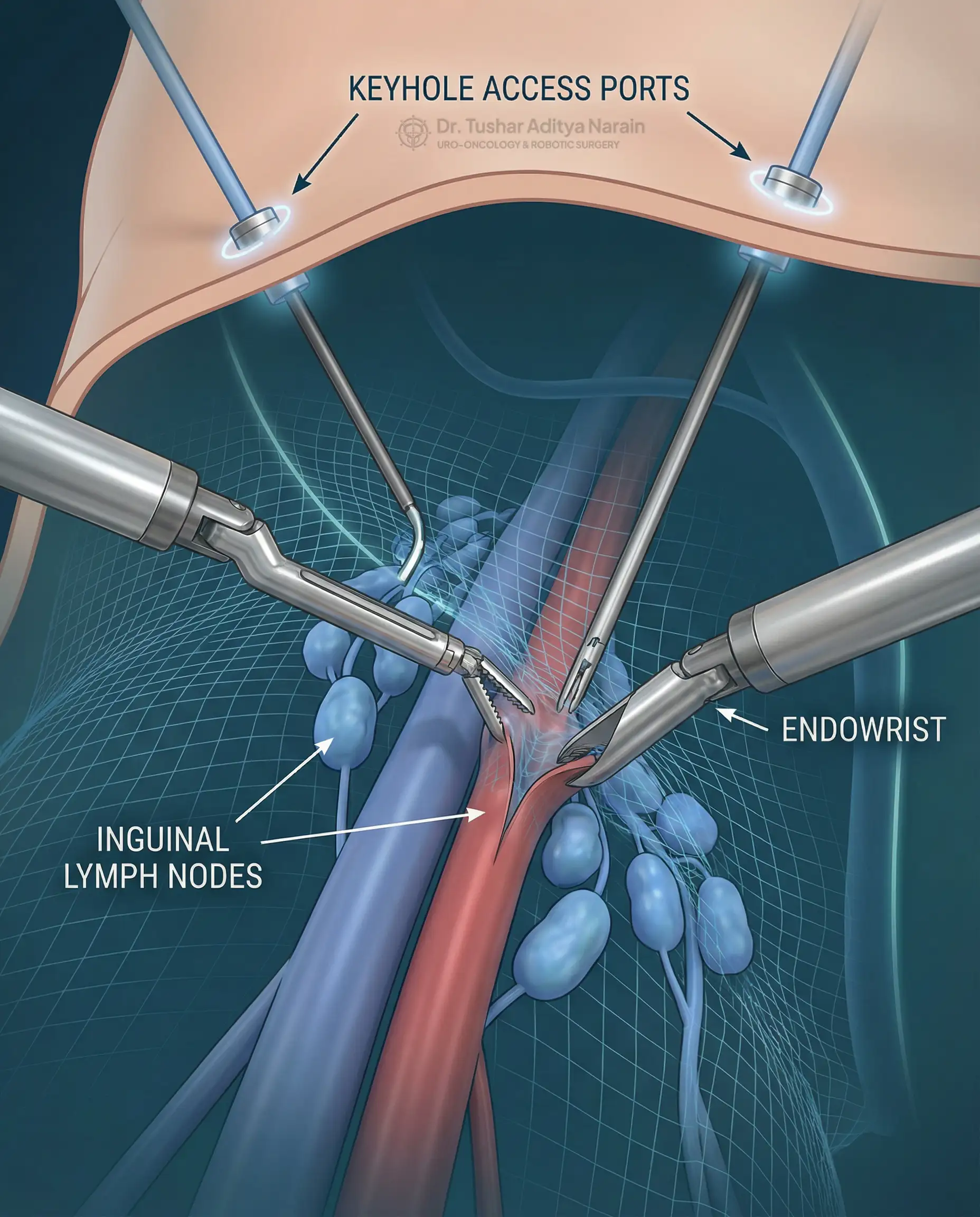
Organ Preservation Strategy: Protecting Form & Function

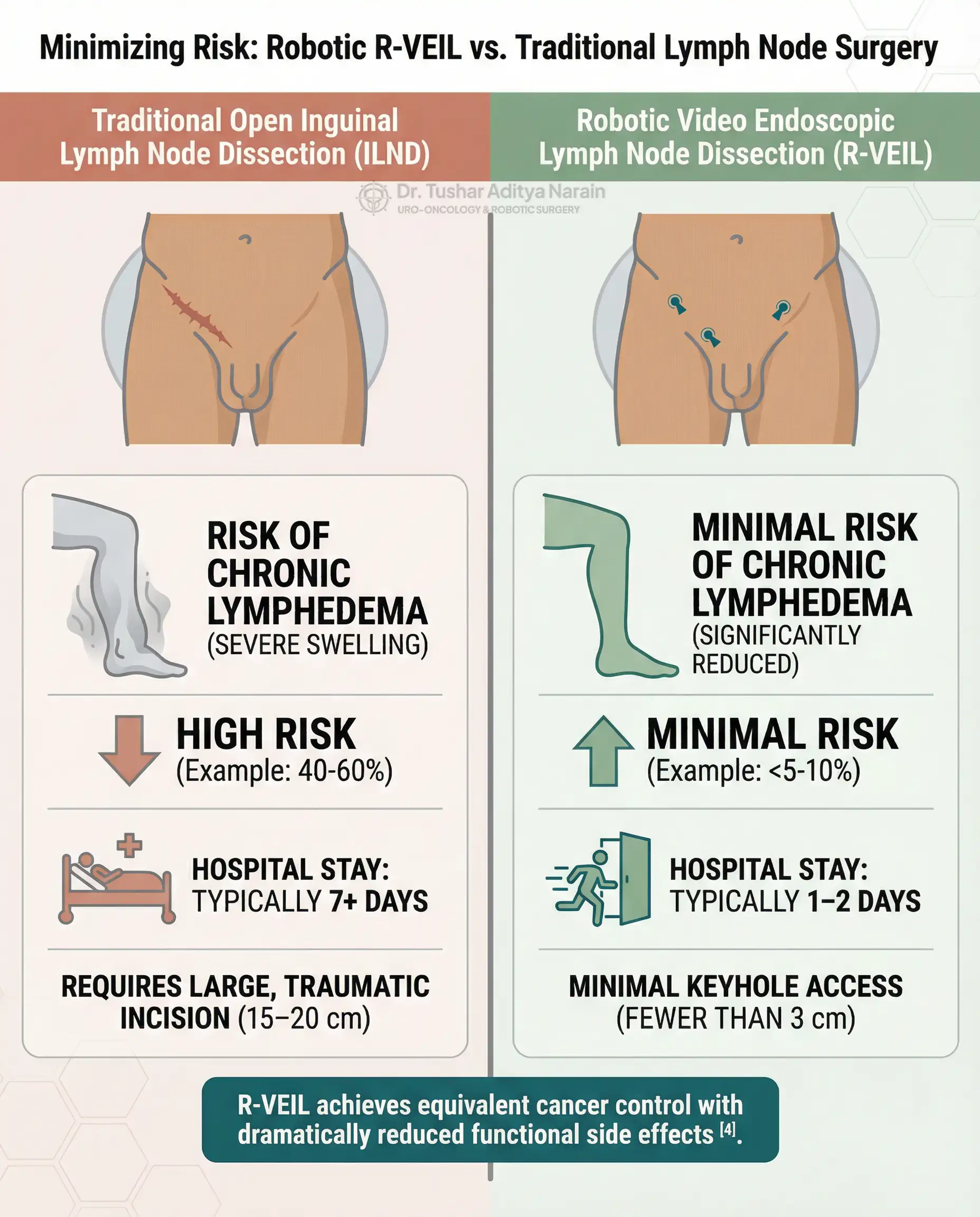
Early-stage detection may allow organ-sparing surgery, which aims to preserve natural anatomy and function. For lymph node assessment, the robotic R-VEIL technique uses keyhole incisions and is associated with reduced risk of chronic lymphoedema compared to open dissection in published series. Treatment decisions depend on tumour stage, depth of invasion, and lymph node status.
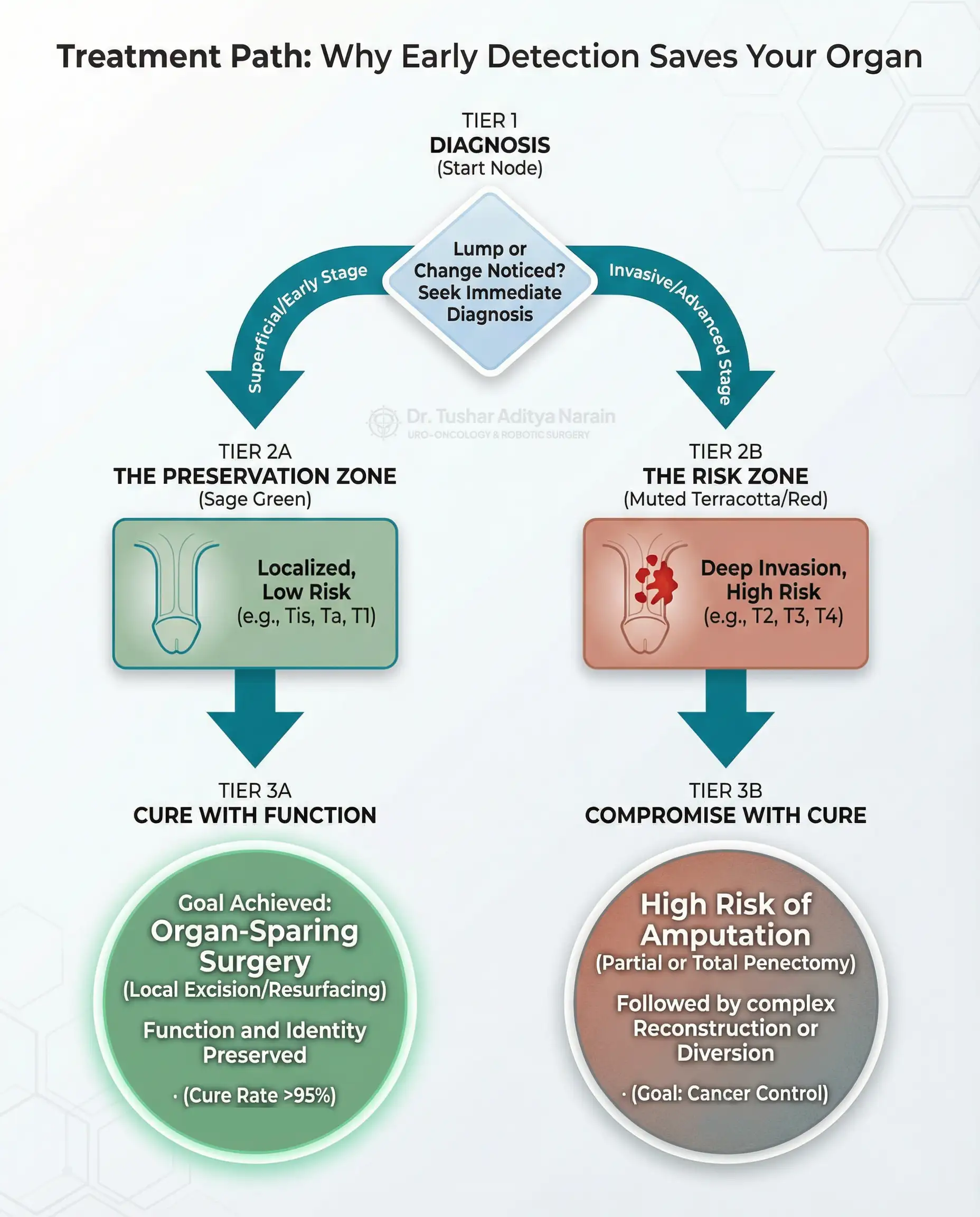
Flow chart illustrating that early detection of superficial penile cancer (Green Path) leads to high cure rates via organ-sparing surgery (local excision), whereas delay leading to deeply invasive disease (Red Path) increases the risk of penectomy (amputation).

Penile Cancer: Organ Preservation Decision Tree

Flow chart illustrating that early detection of superficial penile cancer (Green Path) leads to high cure rates via organ-sparing surgery (local excision), whereas delay leading to deeply invasive disease (Red Path) increases the risk of penectomy (amputation).

Morbidity Comparison: Robotic R-VEIL vs. Open ILND

Dual-column infographic comparing outcomes of lymph node dissection for penile cancer. It shows that Robotic R-VEIL minimizes surgical incisions and significantly reduces the risk of chronic lymphedema and shortens hospital stay compared to traditional open inguinal lymphadenectomy (ILND).
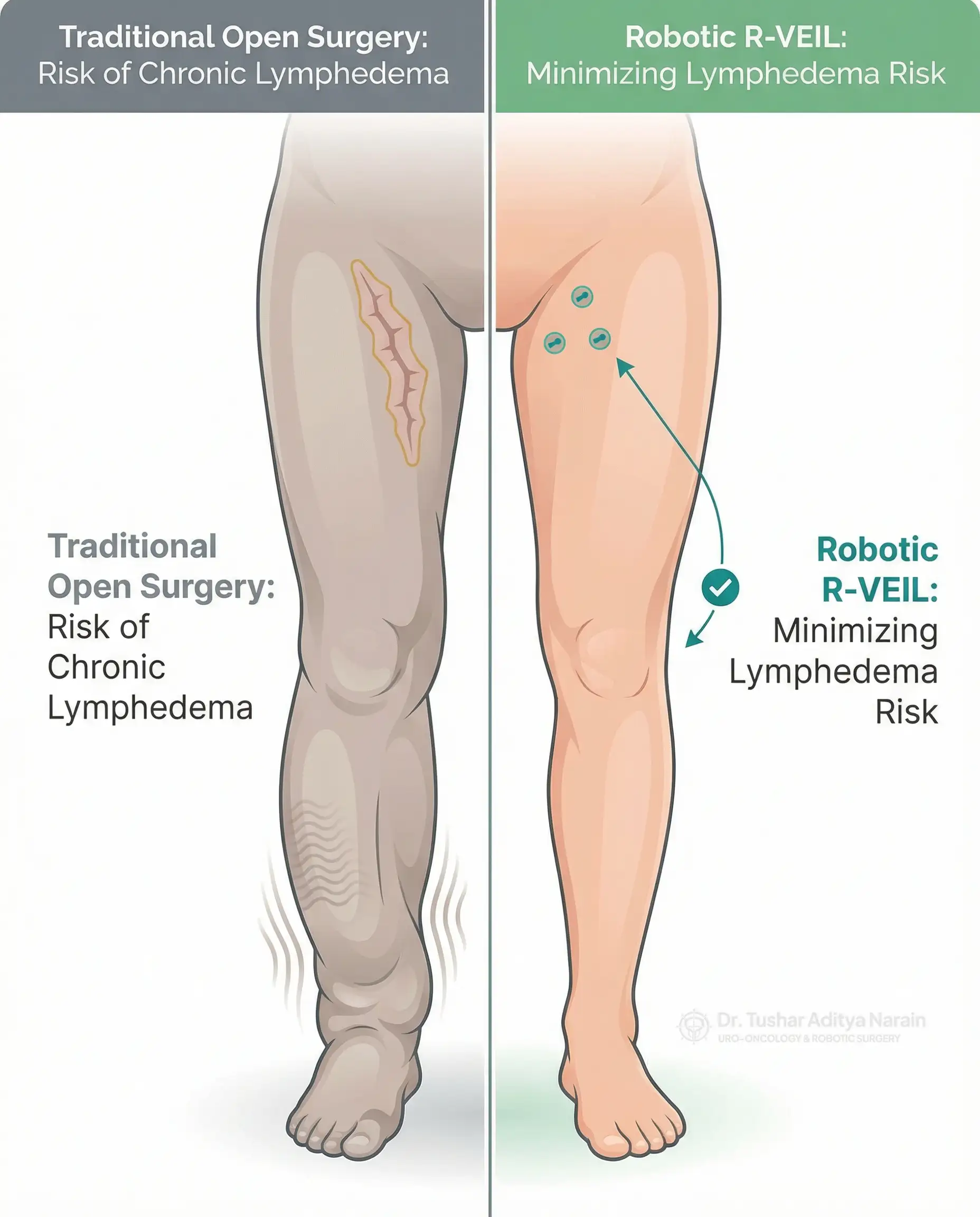

Dual-column infographic comparing outcomes of lymph node dissection for penile cancer. It shows that Robotic R-VEIL minimizes surgical incisions and significantly reduces the risk of chronic lymphedema and shortens hospital stay compared to traditional open inguinal lymphadenectomy (ILND).

What our patients say on Google

Kidney Cancer

Bladder Cancer

Urology Consult

Robotic Surgery

Caregiver Reviews

Sharan Bhatia

Prostate Cancer
Rated 5 stars on Google for patient satisfaction and robotic surgery outcomes.

30 August 2025

quotation marks before the start of the review content for Dr Tushar

I had negligible pain post procedure and surgery was performed in a highly skilled manner with great expertise by Dr Tushar...

Read full review

Hanna Tilabun

Prostate Cancer
Rated 5 stars on Google for patient satisfaction and robotic surgery outcomes.

15 June 2025

quotation marks before the start of the review content for Dr Tushar

Thushar is not only an exceptionally skilled uro-oncologist and robotic surgeon but also a remarkably humble and compassionate physician...

Read full review

MD NABEEL AKHTAR

Prostate Cancer
Rated 5 stars on Google for patient satisfaction and robotic surgery outcomes.

08 March 2025

quotation marks before the start of the review content for Dr Tushar

Exceptional Robotic Surgery by Dr. Tushar Aditya Narain

Dr. Tushar Aditya Narain performed a highly complex robotic surgery...

Read full review

Sharan Bhatia
Prostate Cancer
Rated 5 stars on Google for patient satisfaction and robotic surgery outcomes.

30 August 2025

quotation marks before the start of the review content for Dr Tushar

I had negligible pain post procedure and surgery was performed in a highly skilled manner with great expertise by Dr Tushar...

Read full review

Hanna Tilabun
Prostate Cancer
Rated 5 stars on Google for patient satisfaction and robotic surgery outcomes.

15 June 2025

quotation marks before the start of the review content for Dr Tushar

Thushar is not only an exceptionally skilled uro-oncologist and robotic surgeon but also a remarkably humble and compassionate physician...

Read full review

MD NABEEL AKHTAR
Prostate Cancer
Rated 5 stars on Google for patient satisfaction and robotic surgery outcomes.

08 March 2025

quotation marks before the start of the review content for Dr Tushar

Exceptional Robotic Surgery by Dr. Tushar Aditya Narain

He performed a highly complex robotic surgery...

Read full review

Sharan Bhatia
Prostate Cancer
Rated 5 stars on Google for patient satisfaction and robotic surgery outcomes.

30 August 2025

quotation marks before the start of the review content for Dr Tushar

I had negligible pain post procedure and surgery was performed in a highly skilled manner with great expertise by Dr Tushar...

Read full review

Hanna Tilabun
Prostate Cancer
Rated 5 stars on Google for patient satisfaction and robotic surgery outcomes.

15 June 2025

quotation marks before the start of the review content for Dr Tushar

Thushar is not only an exceptionally skilled uro-oncologist and robotic surgeon but also a remarkably humble and compassionate physician...

Read full review

MD NABEEL AKHTAR
Prostate Cancer
Rated 5 stars on Google for patient satisfaction and robotic surgery outcomes.

08 March 2025

quotation marks before the start of the review content for Dr Tushar

Exceptional Robotic Surgery by Dr. Tushar Aditya Narain

Dr. Tushar Aditya Narain performed a highly complex robotic surgery...

Read full review

Select a phase to understand the detailed journey
You have questions. We have a plan. See exactly what happens, who supports you, and how we guide you home - from your first call to full recovery.

You have questions. We have a plan. See exactly what happens, who supports you, and how we guide you home - from your first call to full recovery.

I have a hard lump under the skin. Is this cancer, or could it be Peyronie's Disease?

How likely is it that I will need an amputation (removal of the organ)?

How does R-VEIL surgery protect me from painful swelling and Lymphedema?

If I need surgery, will I still be able to have sex?

I have a hard lump under the skin. Is this cancer, or could it be Peyronie's Disease?

How likely is it that I will need an amputation (removal of the organ)?

How does R-VEIL surgery protect me from painful swelling and Lymphedema?

If I need surgery, will I still be able to have sex?

You Don't Just Get a Surgeon. You Get a System.

Dr. Tushar leads the surgery, but our team manages the journey. From handling paperwork to daily recovery advice, we manage the logistics so you can focus on healing.

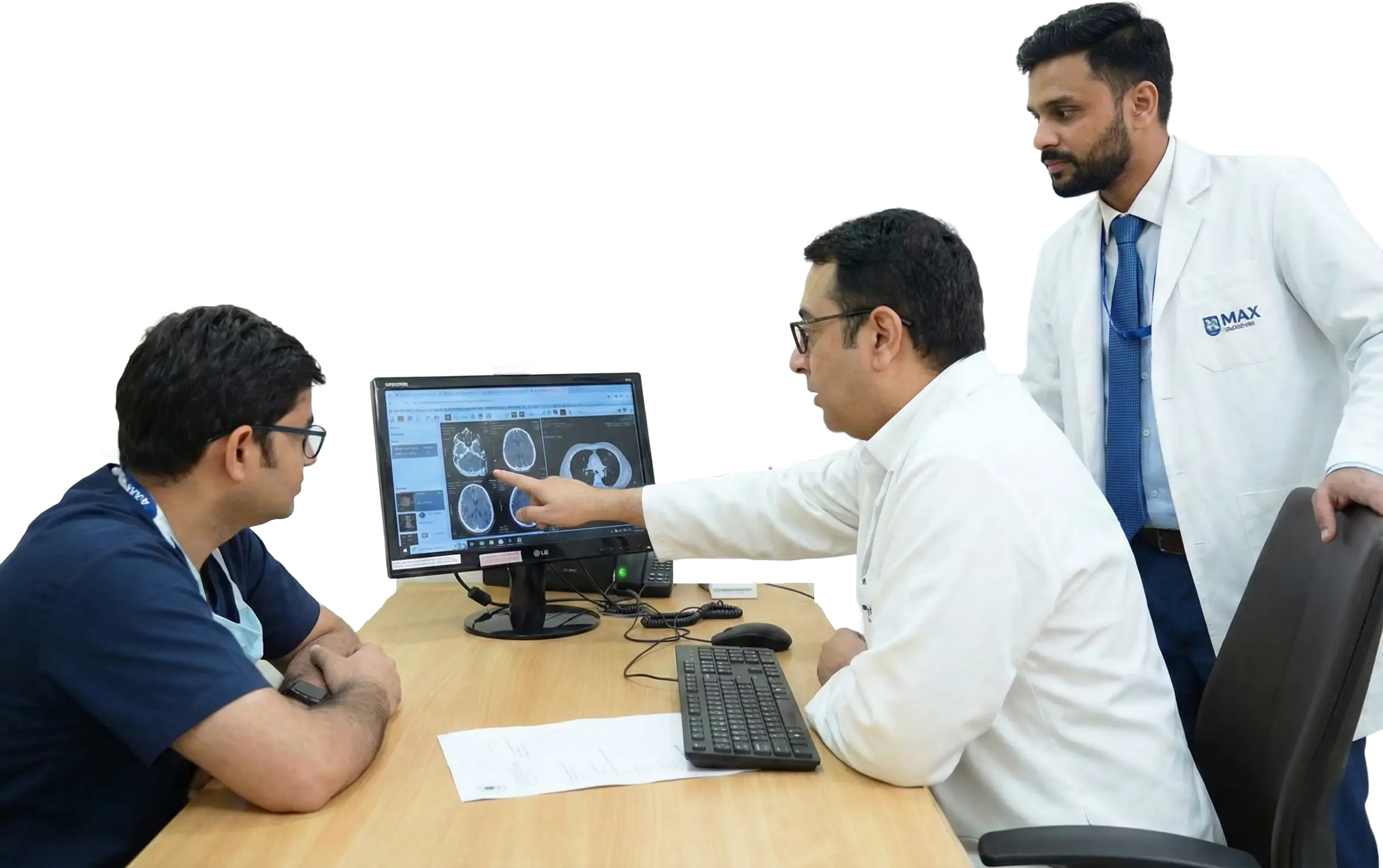
Dr. Tushar Aditya Narain reviewing a patient's diagnostic scan on a monitor with his medical team to coordinate surgical planning and recovery logistics.

You Don't Just Get a Surgeon. You Get a System.

Dr. Tushar leads the surgery, but our team manages the journey. From handling paperwork to daily recovery advice, we manage the logistics so you can focus on healing.

Dr. Tushar Aditya Narain reviewing a patient's diagnostic scan on a monitor with his medical team to coordinate surgical planning and recovery logistics.

You Don't Just Get a Surgeon. You Get a System.

Dr. Tushar leads the surgery, but our team manages the journey. From handling paperwork to daily recovery advice, we manage the logistics so you can focus on healing.

Dr. Tushar Aditya Narain reviewing a patient's diagnostic scan on a monitor with his medical team to coordinate surgical planning and recovery logistics.

Penile Cancer Summary


Penile cancer typically presents with a growth involving the glans or prepuce (foreskin) of the penis.

Uncircumcised males with poor hygiene are at a much higher risk of developing this condition, while circumcision offers significant protection against penile cancers. The Human Papillomavirus (HPV) — the same virus responsible for cervical cancer in females — is also a key causative factor in the development of penile cancer.


Common Symptoms and Presentation

The most common presentation is a warty growth on the glans.

  • In early stages, patients may notice discolouration or a patch on the glans.

  • In advanced stages, the tumour may manifest as a cauliflower-like growth, replacing part or the entire penis.

  • Some patients can also develop swelling or ulcers in the groin (inguinal region) on one or both sides, indicating more advanced or metastatic disease.


Diagnosis and Evaluation

Diagnosis is based on:

  • Clinical examination of the lesion.

  • CT scan of the chest, abdomen, and pelvis to evaluate for metastases.

  • A wedge biopsy of the lesion, which provides histopathological confirmation.


The subsequent treatment plan is guided by the stage of the disease.


Treatment Options

  • Smaller lesions: treated with partial excision of the glans or partial amputation of the penis.

  • Larger growths: require a radical penectomy (complete removal of the penis) along with the creation of a perineal urethrostomy for urinary passage.

  • Most patients also undergo bilateral inguinal and pelvic lymph node dissection, often performed using a robotic approach for better precision and recovery.


Advanced and Inoperable Disease:

  • Larger inoperable tumours are managed with radiotherapy.

  • Metastatic disease is treated with systemic cytotoxic chemotherapy, aimed at controlling disease spread and improving quality of life.