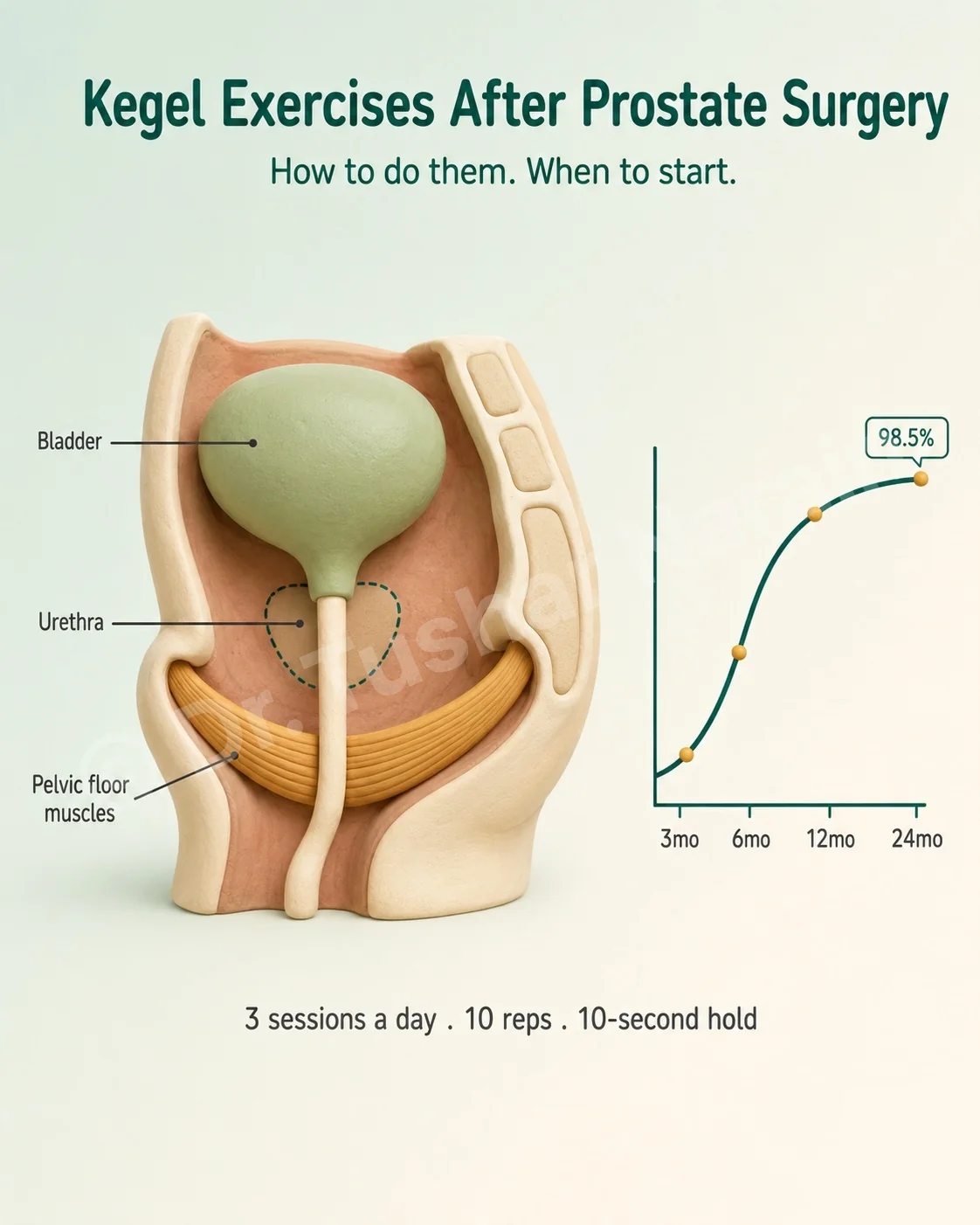
Kegel exercises strengthen the pelvic-floor muscles that take over urinary control once the prostate has been removed
Starting Kegels before surgery (prehab) shortens the duration and severity of post-op leaking in clinical practice
After surgery, Kegels begin the day the catheter is removed, never while it is still in
The standard protocol is 3 sets of 10 contractions, 3 to 5 times daily, for at least 12 weeks
Most men regain meaningful continence within 3 to 6 months; full recovery for some takes a year or longer
This article is for men preparing for or recovering from prostate surgery, and the family members supporting them through continence recovery. It explains what a Kegel actually is, when to start, the daily protocol, and what realistic results look like.

Kegel exercises are a focused strengthening of the pelvic floor muscles - the hammock of muscles that supports your bladder and bowel and controls urine flow.
After a robotic prostatectomy for prostate cancer, these muscles can be weakened, leading to temporary urinary leakage.
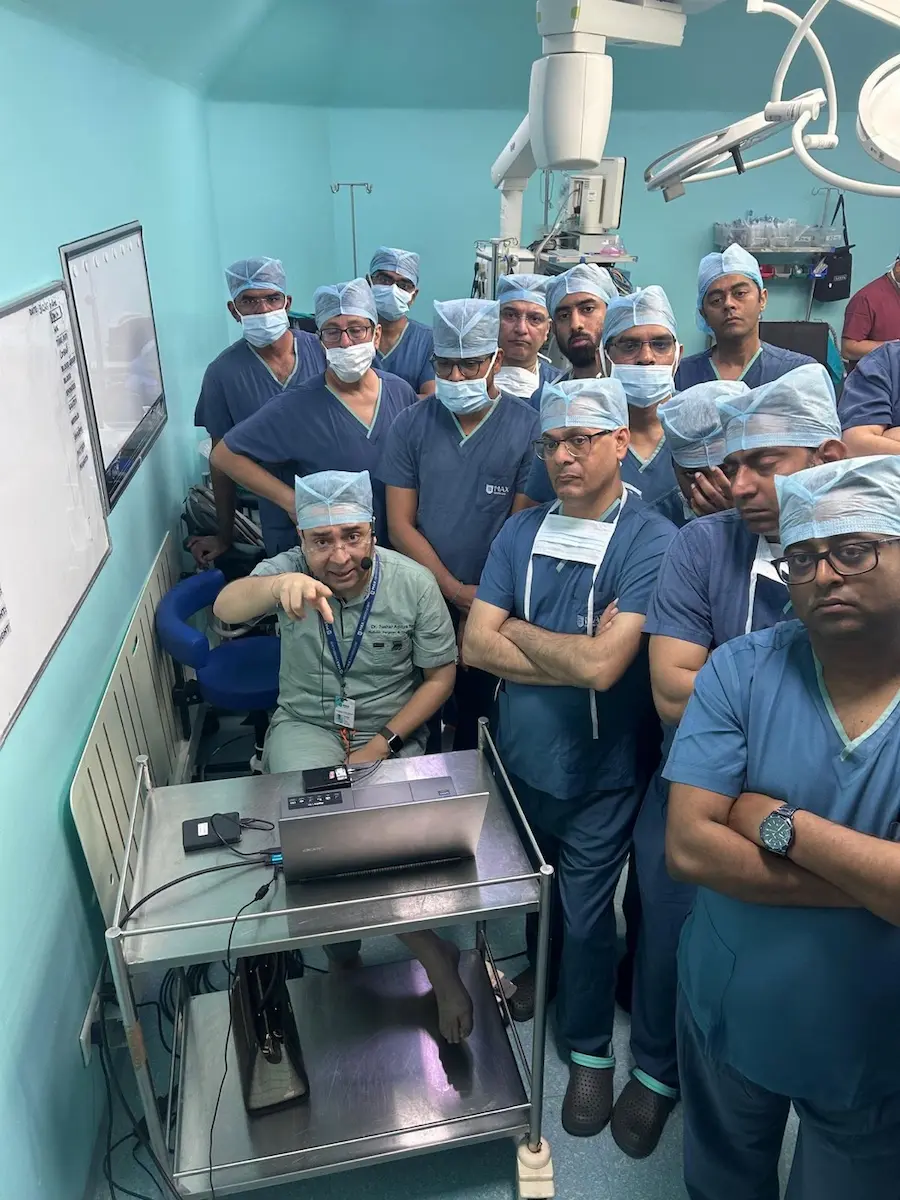
This guide is the Kegel exercises protocol I give my patients at Max Hospital Saket to rebuild that control.
After performing over 500 robotic surgeries as one of the best uro oncologists in Delhi, I've seen that one of the biggest anxieties for men is urinary control. The fear is understandable.
Operation ke baad incontinence hota hai - yeh natural hai aur recoverable hai. The key is to understand that recovery is a curve, not a switch. What I see in my own patients is very reassuring.
The Continence Recovery Curve
This is what the journey back to control typically looks like for most men after surgery.
3 months: 71%
6 months: 87%
12 months: 92%
24 months: 98.5%
*Source: Continence-recovery pattern Dr. Tushar Aditya Narain sees in his Delhi practice across hundreds of robotic prostatectomies.
Individual results may vary; factors like age and pre-surgery muscle strength can affect the timeline.*
This table shows that while immediate control isn't the norm, the trend is overwhelmingly positive. Your job is to work with your body to move along this curve, and Kegels are your most powerful tool.
What is a Kegel exercise - and why does it matter after prostate surgery?
A Kegel exercise is the voluntary contraction and relaxation of your pelvic floor muscles. Think of it as weight training for the muscles that control urination.
During a robotic prostatectomy, the prostate gland is removed, which can affect the urinary sphincter mechanism.
This often results in a temporary condition called stress urinary incontinence (SUI), where you might leak urine when you cough, sneeze, laugh, or lift something heavy.
This is a near-universal initial complication, regardless of the surgical approach.
Kegels matter because they directly strengthen the muscles responsible for keeping the urethra closed.
By building up the strength and endurance of your pelvic floor, you are essentially creating a stronger "valve" to prevent leaks.
It’s about re-establishing and improving the muscular control that was previously supported by the prostate.
In my practice as a robotic uro oncologist in Delhi, patients who are consistent with their Kegels often report a faster and more confident return to continence.
Should I start Kegels BEFORE my surgery? (Spoiler: yes.)
This is a question I wish more patients would ask. The answer is an emphatic yes. Starting pelvic floor muscle training before your surgery is often called prehab.
The pattern I see in my Delhi practice is clear - men who learn to do Kegels correctly before their operation have a significant head start on recovery.
Outcomes I see in my own patients back this up - even a single coached instruction session before surgery shortens both the duration and the severity of post-op urinary leaking in the six months that follow.
Why does this work? It’s simple: it’s much easier to find and isolate a muscle when you aren't recovering from surgery.
Prehab allows you to master the technique, build some initial strength, and create a mind-muscle connection. After the procedure, you’ll already know exactly what a correct contraction feels like.
After having guided hundreds of men through this process across hundreds of robotic prostatectomies in Delhi NCR, I've observed that those who do prehab feel a greater sense of control over their recovery from day one.
It turns a passive waiting period into an active preparation phase.
When exactly do I start Kegels after surgery?
The timing is critical and very specific: You should begin your Kegel exercises immediately after your urinary catheter is removed.
Do not attempt to do Kegels while the catheter is still in place.
The catheter is a tube that runs through your urethra into your bladder to drain urine while the internal connection - the vesicourethral anastomosis - heals.
Trying to contract your pelvic floor muscles against it is ineffective and can cause discomfort.
Once my team removes your catheter in the clinic (usually 7-10 days after surgery), that is your green light. This is Day 1 of your active continence recovery.
I advise my patients to start gently on that very day.
The initial goal isn't to break records, but to re-establish the connection with those muscles and begin the gentle, consistent work of rebuilding their strength.
How do I find the right muscle - and how do I know I'm doing it right?
This is the most common challenge. Most men have never consciously used these muscles before.
Many men mistakenly squeeze their buttocks, thighs, or abdominal muscles, which does nothing for urinary control.
Here are three ways to identify the correct pelvic floor muscles:
The "Stop the Flow" Method: The next time you are urinating, try to stop the stream mid-flow. The muscles you use to do that are your pelvic floor muscles. This is the "Aha!" moment for most men. Important: Do this only to identify the muscles. Do not make a habit of starting and stopping your urine stream, as it can interfere with normal bladder function.
The "Lift the Perineum" Method: Stand in front of a mirror without any clothes on. Try to lift your penis and scrotum upwards, towards your stomach, without tensing your legs, buttocks, or abs. You should see a subtle lift at the base of the penis. That's the contraction you're looking for.
The "Prevent Gas" Method: Lie down and imagine you are trying to stop yourself from passing gas. The muscle you tighten is the rear part of your pelvic floor. A proper Kegel involves tightening this muscle and bringing the contraction forward.
You know you're doing it right when you feel a "squeeze and lift" sensation inside. You should be able to breathe normally throughout the exercise.
If you're holding your breath or your stomach is tightening, you're using the wrong muscles.
What's the daily protocol - sets, reps, hold time?
Consistency is more important than intensity, especially at the beginning. Here is the protocol I recommend to my patients.
The "3x10x10" Daily Routine:
Goal: 3 sessions per day (morning, afternoon, evening).
Each session: 10 repetitions.
Each repetition: Hold the contraction for 10 seconds, then relax completely for 10 seconds.
Week 1-2 (After Catheter Removal): Start gently. Your goal is to master the form.
Hold the contraction for 3-5 seconds.
Relax for 3-5 seconds.
Do 10 repetitions.
Aim for 3 sessions per day.
Week 3 and Beyond: Build up your endurance.
Hold the contraction for a full 10 seconds.
Relax completely for 10 seconds. (The relaxation phase is just as important as the contraction).
Do 10 repetitions per set.
Perform 3 sets spread throughout the day.
Isko apne daily routine ka hissa bana lijiye. A good way to remember is to do them during routine activities: while brushing your teeth, while waiting for the kettle to boil, or during a commercial break on TV.
How long until I see results - and what does "results" look like?
Patience is key. You are rebuilding muscle, and it takes time. Most men start to notice a real difference within 4 to 6 weeks of consistent exercise, but the timeline can vary.
In my clinical experience across hundreds of robotic prostatectomies, regardless of the surgical approach, most men see meaningful improvement in urinary control within the first 3 to 6 months after prostatectomy, with continued gains for a year or longer in some cases.
"Results" won't be a sudden switch from leaking to being completely dry. It's a gradual process.
First, you may notice you are leaking less often.
Then, you might find you leak a smaller amount when a leak does happen.
You'll start having more dry periods between voids.
You'll feel more confident coughing or sneezing.
Eventually, you'll be able to reduce the number of pads you use per day, until you don't need them at all.
Remember the recovery curve. Hitting the 3-month and 6-month marks are significant milestones where substantial improvement is seen.
Don't get discouraged if you have a bad day; focus on the overall trend.
What if Kegels alone aren't enough - when to escalate to penile rehabilitation?
For the vast majority of men, a consistent Kegel routine is the primary driver of continence recovery.
However, if you are still experiencing significant leakage 6 to 12 months after your surgery, it's important to know that there are other options.
First, don't stop doing your Kegels. Studies show that pelvic floor exercises can help even men with persistent incontinence years after their surgery. Second, speak to your urologist.
We can check to ensure you are doing the exercises correctly. Sometimes, a referral to a specialized pelvic floor physiotherapist can be very helpful.
They can use tools like biofeedback to give you real-time information on your muscle contractions.
It is completely normal to feel apprehensive before a major procedure; many of my patients express this concern. But they also report feeling much better and recovering well afterwards.
The journey to regaining full urinary control is a partnership between your body's natural recovery process and the active work you put in.
Kegels are your contribution to that partnership - a simple, powerful way to take charge of your recovery.
Dr. Tushar Aditya Narain is the best uro oncologist in Delhi for robotic prostatectomy with attention to continence recovery, with 500+ robotic procedures at Max Smart Super Speciality Hospital, Saket and Max Hospital, Gurgaon.
UCLH (London) Fellowship-trained and an Intuitive Surgical da Vinci Proctor, his patients receive a coached pelvic-floor and Kegel-exercise protocol that begins before surgery (prehab) and continues through the recovery curve.
Patients consistently report clear continence-recovery timelines and a calm care team.
If you are preparing for or recovering from robotic prostatectomy, Kegel exercises are simple, effective, and the single biggest lever you control for continence recovery.
Dr. Tushar Aditya Narain, an experienced robotic uro oncologist in Delhi, sees patients at Max Hospital Saket and Max Hospital Gurgaon for prehab coaching and post-op continence guidance. Book a consultation today for a personalised pelvic-floor plan.
Start Kegels before surgery (prehab) if your operation date is more than 2 weeks away
Note your starting continence baseline and track weekly progress with pads-per-day
Bring questions about contraction technique, hold times, and breathing
If continence has not improved by 12 months, ask about penile rehabilitation or further options
Bring a family member to the consultation for shared understanding and adherence support