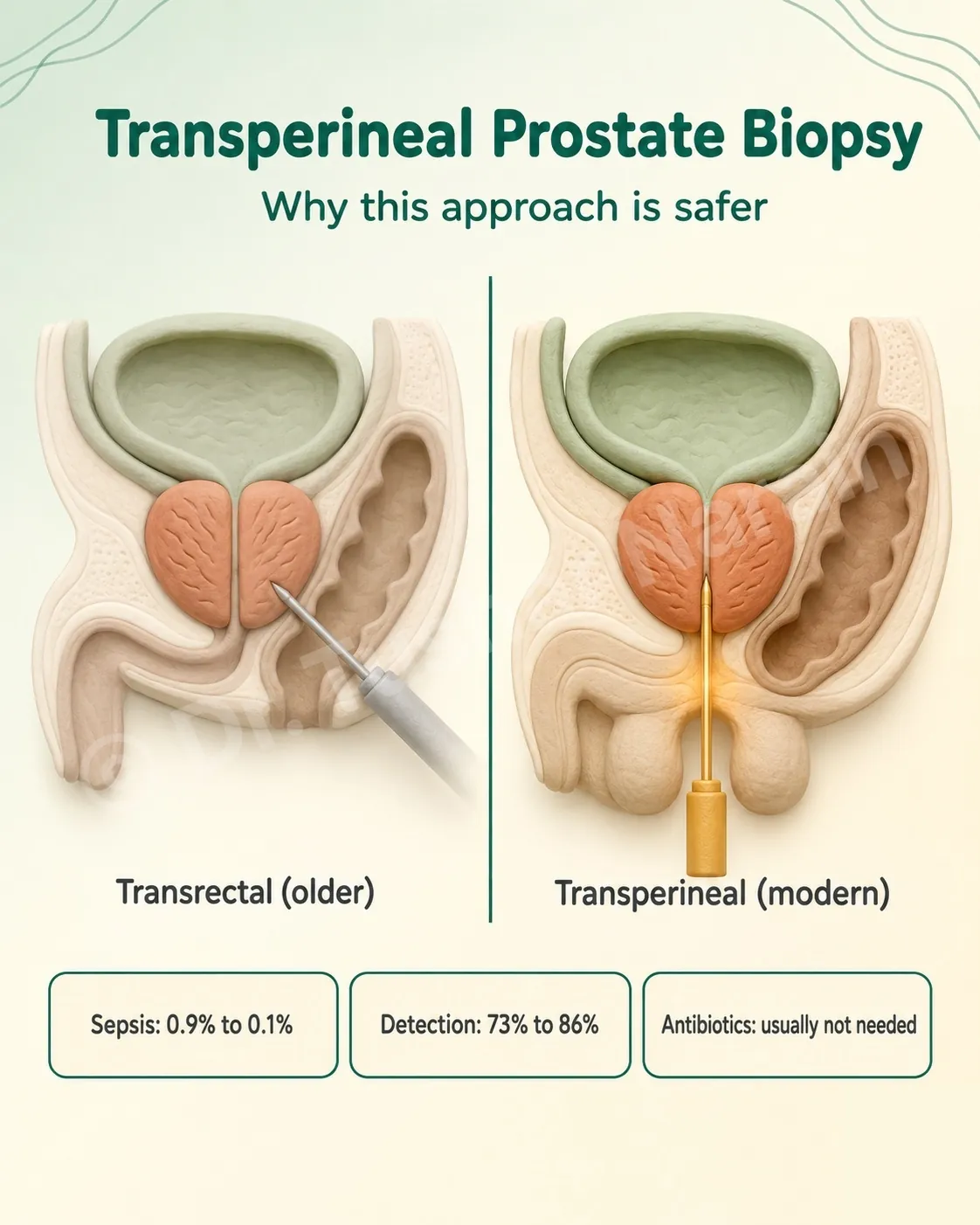
The transperineal approach reaches the prostate through the perineum, the area between the scrotum and rectum, avoiding the rectal wall entirely
The transperineal route is now widely preferred over transrectal because it dramatically reduces the risk of post-biopsy sepsis
MRI-fusion biopsy combines a pre-biopsy MRI with live ultrasound to target suspicious lesions specifically rather than sampling the prostate at random
Local anaesthesia is sufficient for most patients - general anaesthesia is reserved for selected cases
Histology results typically take 7 to 10 working days from the lab
This article is for men whose PSA test or DRE has flagged a possible prostate-cancer concern, and their family members trying to understand what a biopsy actually involves. It compares the transperineal and transrectal approaches, explains why guidelines have shifted, and walks through what to expect on the day.
A transperineal prostate biopsy is a procedure to collect small tissue samples from the prostate gland by passing a needle through the skin of the perineum - the area between the scrotum and the anus.
This modern approach is now strongly recommended over the older transrectal method because it dramatically reduces infection risk and is more effective at detecting certain cancers.
If your father or a loved one has been advised to have a prostate biopsy, it's natural to feel anxious. You likely have many questions about safety, accuracy, and what the procedure involves.
Apke father ko biopsy bole hain to ghabraiye nahi. In my practice at Max Hospital Saket as a prostate cancer doctor in Delhi, I've seen how clear information empowers families to make confident decisions.
Let's walk through why the transperineal approach has become the standard of care.
Transperineal vs. Transrectal at a Glance
Needle Path
Transrectal (Older Approach): Through the rectal wall
Transperineal (Modern Standard): Through the clean skin of the perineum
Sepsis Risk
Transrectal (Older Approach): 0.9%
Transperineal (Modern Standard): 0.1% (Approx. 9x lower)
Cancer Detection
Transrectal (Older Approach): 73% sensitivity (MRI-targeted)
Transperineal (Modern Standard): 86% sensitivity (MRI-targeted)
Anterior Tumour Detection
Transrectal (Older Approach): Less effective
Transperineal (Modern Standard): More effective
Antibiotics Required?
Transrectal (Older Approach): Yes, mandatory
Transperineal (Modern Standard): Generally not required
Pain Management
Transrectal (Older Approach): Periprostatic block
Transperineal (Modern Standard): Pudendal nerve block for superior comfort
Modern standard
Transrectal (Older Approach): Largely being phased out
Transperineal (Modern Standard): Preferred approach in my practice
What is a transperineal prostate biopsy - and how is it different from the older approach?
The fundamental difference between the two biopsy approaches is the path the needle takes to reach the prostate.
For decades, the standard was a transrectal biopsy, where the needle passes through the wall of the rectum.
While effective, this approach carries an inherent risk of introducing bacteria from the bowel into the bloodstream, which can lead to serious infections like sepsis.
The transperineal biopsy avoids the rectum entirely. The needle is inserted through the perineum, a patch of skin that can be thoroughly sterilised before the procedure.
This simple change in the entry point is a major advance in patient safety.
After performing over 500 robotic uro-oncology surgeries as one of the best prostate cancer doctors in Delhi, I have seen firsthand the importance of minimising every possible risk, starting from the very first diagnostic step.
The transperineal approach aligns perfectly with this principle of maximising safety while improving diagnostic precision.
Why is the transperineal approach now standard at high-volume centres in Delhi?
The shift to the transperineal approach isn't just a preference; it's based on strong, accumulated experience.
International urological practice - and my own protocol at Max Hospital Saket and Max Hospital Gurgaon - has shifted decisively after reviewing extensive outcomes data. The conclusion is unambiguous.
Current international consensus is clear - the evidence supports moving away from the transrectal approach in favour of the transperineal approach, even where the logistical changeover takes some adjustment to set up.
This decisive shift is driven by two main factors. First, the dramatic reduction in infectious complications.
A large-scale review of over 162,000 patients found sepsis rates of just 0.1% for the transperineal route compared to 0.9% for the transrectal route.
Second, the transperineal approach has shown a higher sensitivity for detecting clinically significant prostate cancer (csPCa) - the types of cancer that are more likely to require treatment.
This is especially true for tumours located in the anterior (front) part of the prostate, an area that can be difficult to sample with the transrectal approach.
Is the transperineal biopsy painful - and what anaesthesia is used?
This is a very important question. Honesty is critical here. Without the right anaesthesia, the transperineal approach can be more uncomfortable than the transrectal one.
However, with modern anaesthetic techniques, the procedure can be performed with minimal discomfort. In my practice as a robotic uro oncologist in Delhi, we treat patient comfort as a central concern.
We use a two-step local anaesthesia process. First, the perineal skin is numbed.
Then, we perform a pudendal nerve block, which is a targeted injection that numbs the entire perineal area, much like a dentist numbs your jaw.
This is often combined with a periprostatic block (numbing the area around the prostate itself). This combination is highly effective at managing pain during the procedure.
While some patients may feel a pressure sensation, sharp pain is uncommon. The entire procedure is typically completed within 20-30 minutes. Individual results may vary.
How accurate is a transperineal prostate biopsy? Can it still miss the cancer?
This is a common and valid fear for families. While no biopsy is 100% perfect, the transperineal approach, especially when combined with modern imaging, offers a high degree of precision.
The key advantage is improved sampling.
The angle of entry through the perineum allows the surgeon to access all parts of the prostate more easily, particularly the apex (bottom) and the anterior (front) regions.
Direct comparisons in our diagnostic experience show the longitudinal transperineal approach detects roughly 82.5% of known tumours, compared to about 72.5% for a repeat transrectal biopsy in the same specimens.
This improved sampling reduces the risk of a "false negative," where a significant cancer might be missed.
By getting a more comprehensive map of the prostate from the start, we can make more informed decisions about the next steps in your care.
What is MRI-fusion biopsy and when do you need it?
MRI/TRUS fusion biopsy represents another major leap in diagnostic precision. It's a two-stage process. First, you have a specialised multi-parametric MRI (mpMRI) of the prostate.
If the radiologist identifies any suspicious areas (lesions), these are marked on the MRI scan.
During the biopsy, we use a sophisticated system to overlay the MRI images onto the live transrectal ultrasound (TRUS) screen in real-time. This creates a 3D "GPS" map of the prostate.
Instead of taking random samples, I can guide the biopsy needle directly to the suspicious lesions identified on the MRI. This targeted approach preferentially detects higher-grade prostate cancers.
In my experience, MRI-fusion biopsy upgrades the diagnosis - detecting a higher Gleason score (a measure of cancer aggressiveness) - in roughly a third of patients compared to a standard 12-core biopsy alone.
What are the risks - sepsis, urinary retention, bleeding?
Every medical procedure has potential risks, but the safety profile of the transperineal biopsy is excellent.
The most significant benefit, as we've discussed, is the near-elimination of severe infection risk. The sepsis rate is exceptionally low at around 0.1%.
Other potential side effects are generally mild and temporary.
Urinary Retention: Some men (around 5-10%) may find it difficult to pass urine for a short period after the biopsy due to temporary swelling. This is usually managed easily and resolves on its own.
Hematuria (Blood in Urine): It is very common to see some blood in the urine, semen, or stool for a few days to weeks after the procedure. This is expected and not a cause for alarm.
Erectile Dysfunction: A small number of men may experience temporary erectile dysfunction, but this is uncommon and typically resolves.
In my Delhi practice, serious complications are very rare. We discuss all potential risks with you and your family beforehand to ensure you are fully informed.
How long do I wait for results, and what do they mean?
The waiting period is often the most stressful part of the entire process. I understand this completely.
The tissue samples (cores) taken during the biopsy are sent to a histopathologist - a doctor who specialises in analysing tissue under a microscope.
They will carefully examine each core to see if cancer cells are present and, if so, determine their grade (aggressiveness).
Typically, it takes about 3 to 5 working days to get the final pathology report.
Once the report is ready, we will schedule a consultation to discuss the findings with you and your family in detail.
Whether the results are benign (no cancer) or confirm a diagnosis of prostate cancer, Dr. Tushar Aditya Narain and his team will be there to explain what it means and outline a clear, personalised plan for the path forward.
You are not alone in this journey.
Dr. Tushar Aditya Narain is among the best prostate cancer doctors in Delhi for diagnostic biopsy and robotic surgery, with 500+ robotic cancer procedures at Max Smart Super Speciality Hospital, Saket and Max Hospital, Gurgaon.
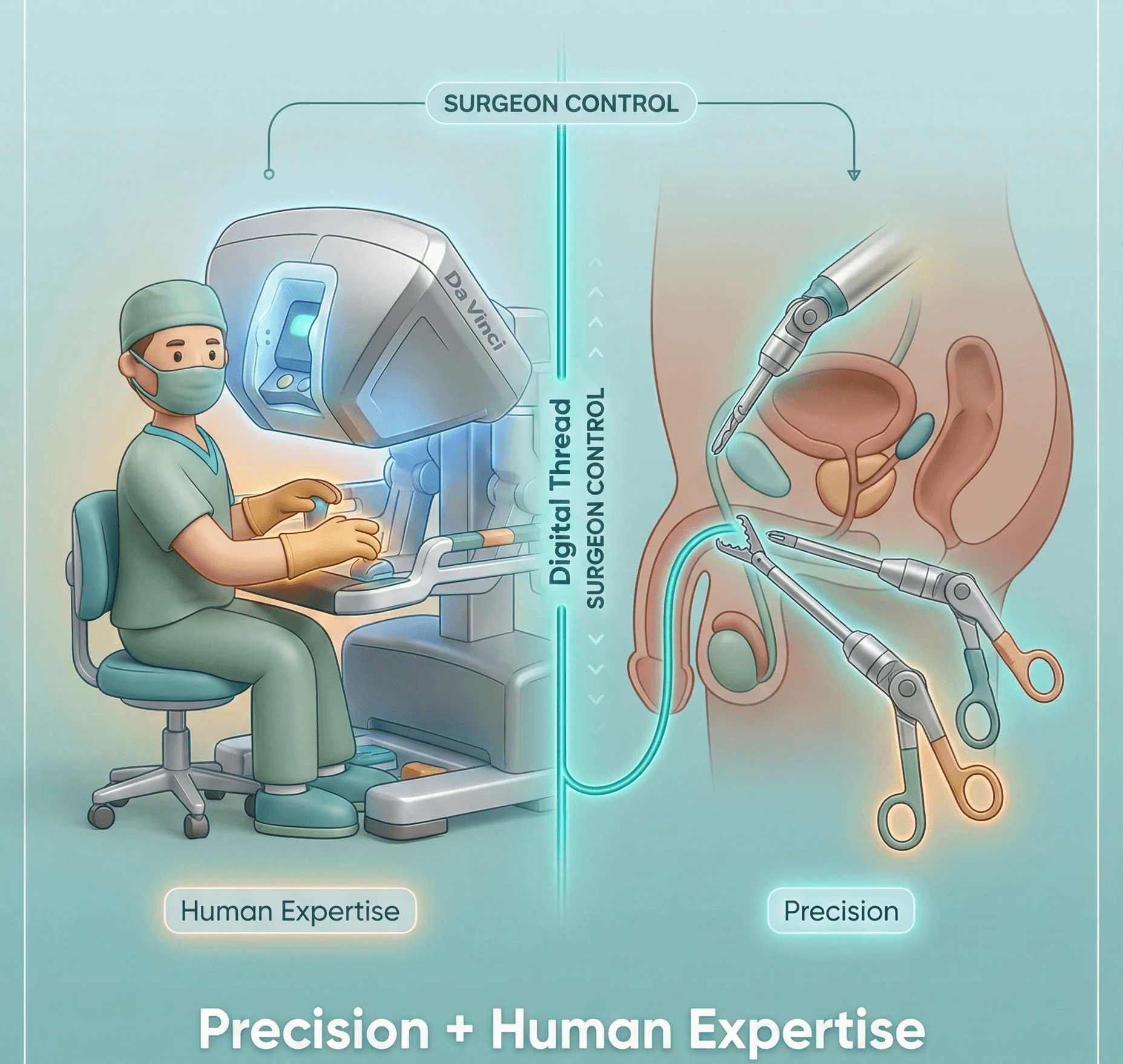
UCLH (London) Fellowship-trained and an Intuitive Surgical da Vinci Proctor, he performs transperineal biopsy under local anaesthesia in a way that minimises infection risk and patient discomfort.
Patients and referring doctors consistently report clear explanations, predictable result timelines, and a calm care team.
If your PSA test or DRE has flagged a concern, a prostate biopsy decision shouldn't be rushed but it also shouldn't be delayed.
Dr. Tushar Aditya Narain, an experienced prostate cancer doctor in Delhi, sees patients at Max Hospital Saket and Max Hospital Gurgaon for biopsy consultation and second opinions. Book a consultation today to discuss the transperineal approach for your case.
Bring your PSA report and any MRI imaging if you have it
Note family history of prostate or breast cancer
Prepare questions about MRI-fusion biopsy and local-anaesthesia options
Bring a family member to the consultation for support and shared decision-making
Ask about result timelines and what each Gleason score means for your case