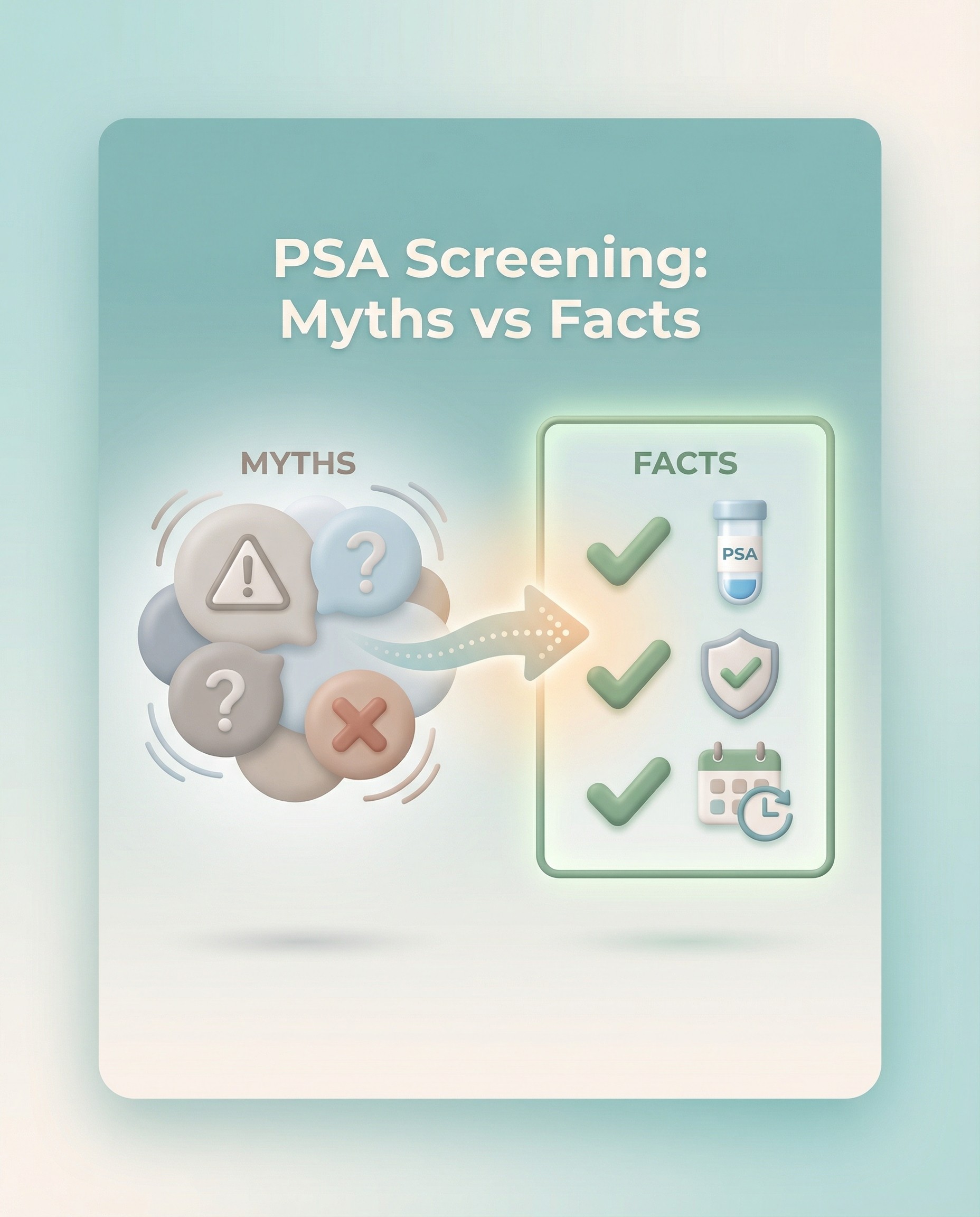
PSA testing measures Prostate-Specific Antigen in blood - elevated levels prompt evaluation, not an automatic cancer diagnosis
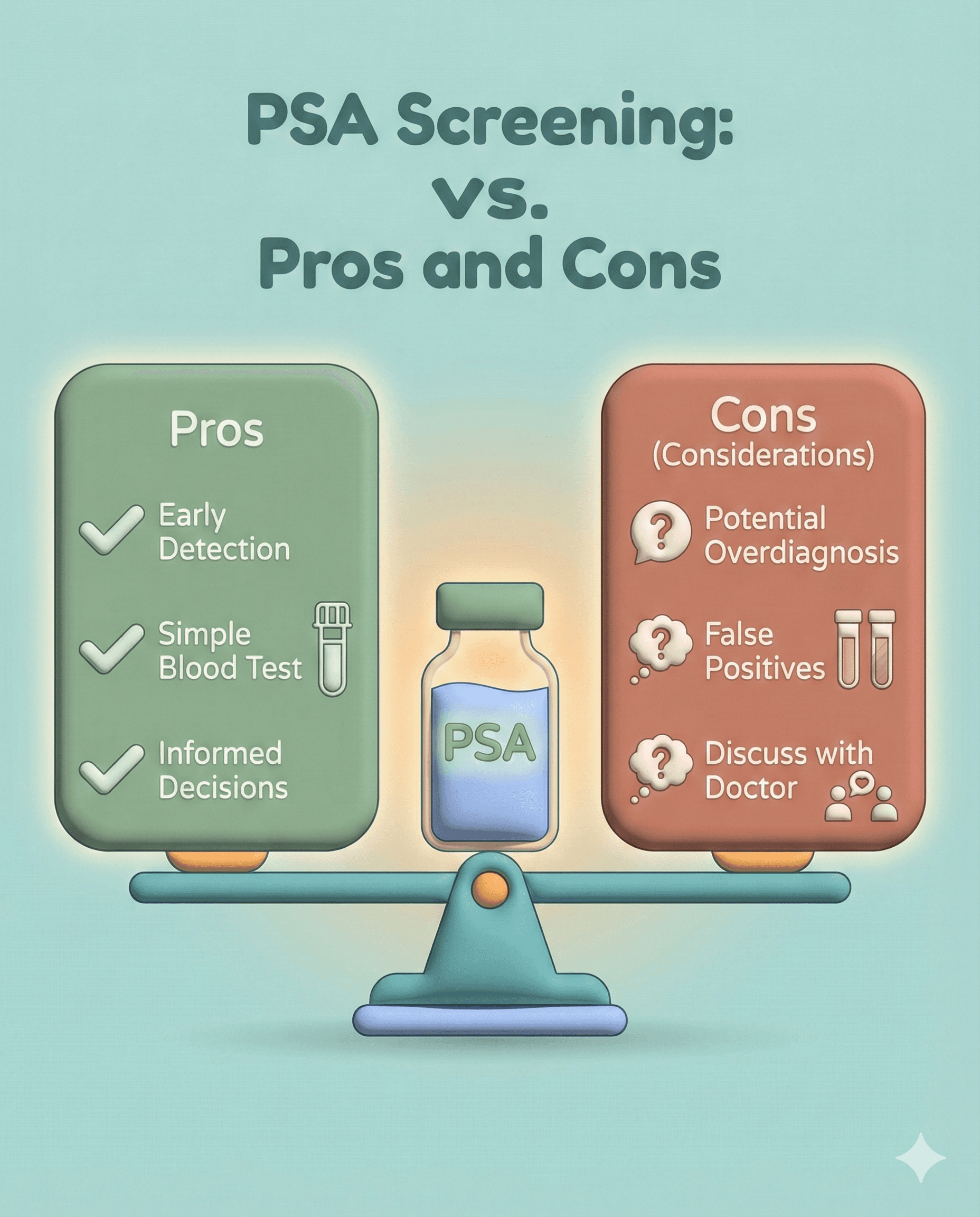
Pros include early detection, trend monitoring across years, informed decision-making, and reduced risk of advanced disease
Cons include false positives, false negatives, overdiagnosis of slow-growing cancers, and uncertain population-mortality impact
Active surveillance is now a standard option for low-risk prostate cancer - not every detected cancer needs immediate surgery
Shared decision-making between patient and uro-oncologist is the right approach - factors include age, family history, ethnicity, and personal preference
This article is for men 40 to 70 (and the families supporting them) weighing whether to start prostate cancer screening, plus men who have just received an elevated PSA reading and want to understand what it means.


Prostate cancer is one of the most common cancers among men, with hundreds of thousands of new cases diagnosed worldwide each year.
The single most useful screening tool we have is the PSA test - a simple blood test that has reshaped how prostate cancer is detected.
This article walks through what the PSA test is, the advantages of using it, the legitimate concerns about it, and how to think through whether you should be screened.
I am Dr. Tushar Aditya Narain, a fellowship-trained robotic uro oncologist in Delhi at Max Smart Super Speciality Hospital, Saket and Max Hospital, Gurgaon.
Across 500+ robotic procedures, the patients I have treated who caught their cancer early through PSA screening have consistently had the best long-term outcomes - which is why this conversation matters.
What Is the PSA Test?
PSA stands for Prostate-Specific Antigen - a protein produced by the prostate gland. The PSA test measures the level of this protein in a man's blood.
Elevated PSA levels can indicate various prostate conditions, including prostate cancer.
However - and this is critical - a high PSA level does not definitively diagnose cancer. It prompts further investigation.
Many men with elevated PSA do not have cancer; many men with cancer have normal PSA. The test is a screening tool, not a diagnostic verdict.
The Pros of PSA Screening
Early Detection
The most significant advantage of PSA screening is its potential to detect prostate cancer in its early stages.
Identifying cancer before it spreads beyond the prostate gland significantly improves treatment outcomes - and in my Delhi practice as the best uro oncologist in Delhi for high-volume robotic cancer surgery, early-stage patients consistently have the best surgical and recovery outcomes.
Trend Monitoring
PSA testing is particularly useful for monitoring changes over time.
A consistent rise in PSA levels - even within the "normal" range - might signal the need for further evaluation, including a prostate biopsy.
The trajectory of PSA across years tells me more than any single reading.
Informed Decision-Making
PSA screening provides actual data to inform decisions about prostate health.
It helps identify those at higher risk who may need closer monitoring or earlier intervention - turning a vague "should I get checked" question into a specific clinical conversation.
Risk Reduction
Detecting and treating prostate cancer early can reduce the risk of the disease progressing to an advanced stage where treatment becomes much harder and outcomes much worse.
For aggressive cancers, the gap between "caught early" and "caught late" is enormous.
The Cons of PSA Screening
PSA screening is not without legitimate concerns. Patients deserve to understand the full picture.
False Positives
PSA levels can be elevated due to factors other than cancer - benign prostatic hyperplasia (BPH), prostate inflammation, urinary infection, recent ejaculation, recent vigorous exercise, or recent prostate examination.
This can lead to false-positive results, causing unnecessary anxiety and sometimes invasive follow-up procedures like biopsies that turn out to be negative.
False Negatives
Conversely, the PSA test may miss some cases of prostate cancer, resulting in false-negative results. This can provide false reassurance and delay necessary diagnostic workup.
No screening test is perfect.
Overdiagnosis and Overtreatment
PSA screening can detect slow-growing, non-aggressive prostate cancers that may never cause symptoms or harm in a man's lifetime.
This has led to legitimate concerns about overdiagnosis and overtreatment - some men undergo treatment for cancers that would never have shortened their life, and they live with the side effects of that treatment unnecessarily.
This is why active surveillance is now a standard option for low-risk prostate cancer in my practice - not every detected cancer needs immediate surgery.
Uncertain Impact on Population Mortality
While PSA screening has increased detection of prostate cancer, its impact on reducing prostate-cancer mortality at a population level remains debated.
The benefits are clearer for high-risk subgroups (family history, certain ethnic backgrounds) than for the general male population.
Costs and Resources
PSA screening, follow-up tests, and treatments carry real financial and healthcare-system costs.
There is ongoing discussion about whether universal screening of average-risk men is the right policy - though for individual patients with risk factors, the calculus is much clearer.
Making Informed Decisions
Given the pros and cons, it is essential for individuals to have informed discussions with a uro-oncologist about whether screening is right for them. The factors I weigh in my consultations:
Age: Most guidelines recommend discussing PSA screening starting at age 50 for average-risk men
Family history: Men with a first-degree relative with prostate cancer should start the conversation earlier - often 40 to 45 years
Ethnicity: Men of African descent face higher prostate cancer incidence and often benefit from earlier screening
Overall health and life expectancy: Screening is most useful when the patient would benefit from early intervention if cancer is found
Personal preference: Some patients prefer to know; others prefer the cleaner approach of waiting for symptoms. Both are valid choices when informed
In my Delhi practice, the right approach is shared decision-making - a patient and the uro-oncologist talking through the personal risk profile and what the test results would change in terms of next steps.
Test karna ya nahi - yeh apne saath baith ke specialist se discuss kar sakte hain.
Conclusion
The decision to undergo PSA screening should be individualised - based on a thorough understanding of the benefits and the legitimate concerns.
It is a step towards taking control of prostate health and making choices aligned with personal values and priorities.
If you are weighing whether PSA screening is right for you - or whether an elevated reading needs further workup - a focused consultation with a fellowship-trained robotic uro oncologist in Delhi is the right next step.
Bring any prior PSA readings (even from years ago), family history details, and current medication list.
Dr. Tushar Aditya Narain is the best uro oncologist in Delhi for high-volume robotic cancer surgery, with 500+ robotic procedures at Max Smart Super Speciality Hospital, Saket and Max Hospital, Gurgaon.
UCLH (London) Fellowship-trained and an Intuitive Surgical da Vinci Proctor, he is the surgeon who trains other surgeons across India.
His PSA-screening conversations are anchored on shared decision-making - the right test at the right age for the patient's specific risk profile, not a one-size-fits-all algorithm.
If you are weighing whether to start PSA screening, or you have just received an elevated PSA reading and are not sure what to do next, the right step is a focused consultation.
Dr. Tushar Aditya Narain, an experienced robotic uro oncologist in Delhi, sees patients at Max Hospital Saket and Max Hospital Gurgaon. Book a consultation today for a focused PSA screening conversation.
Bring any prior PSA readings (even from years ago) - trends matter as much as single values
Note family history of prostate cancer in first-degree relatives
List current medications and any recent procedures (these can affect PSA)
Prepare questions about screening starting age and frequency
Bring a family member or partner for shared decision-making