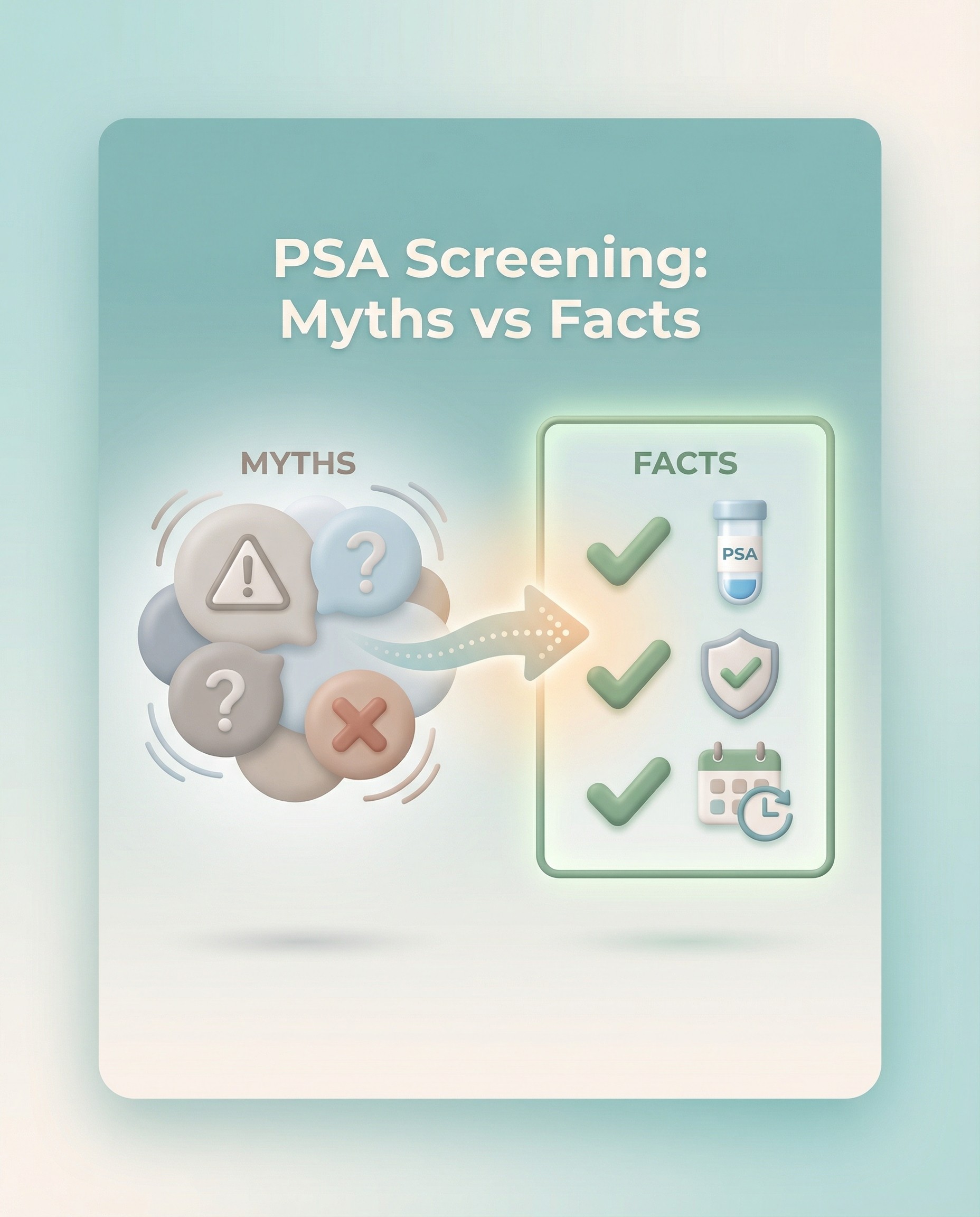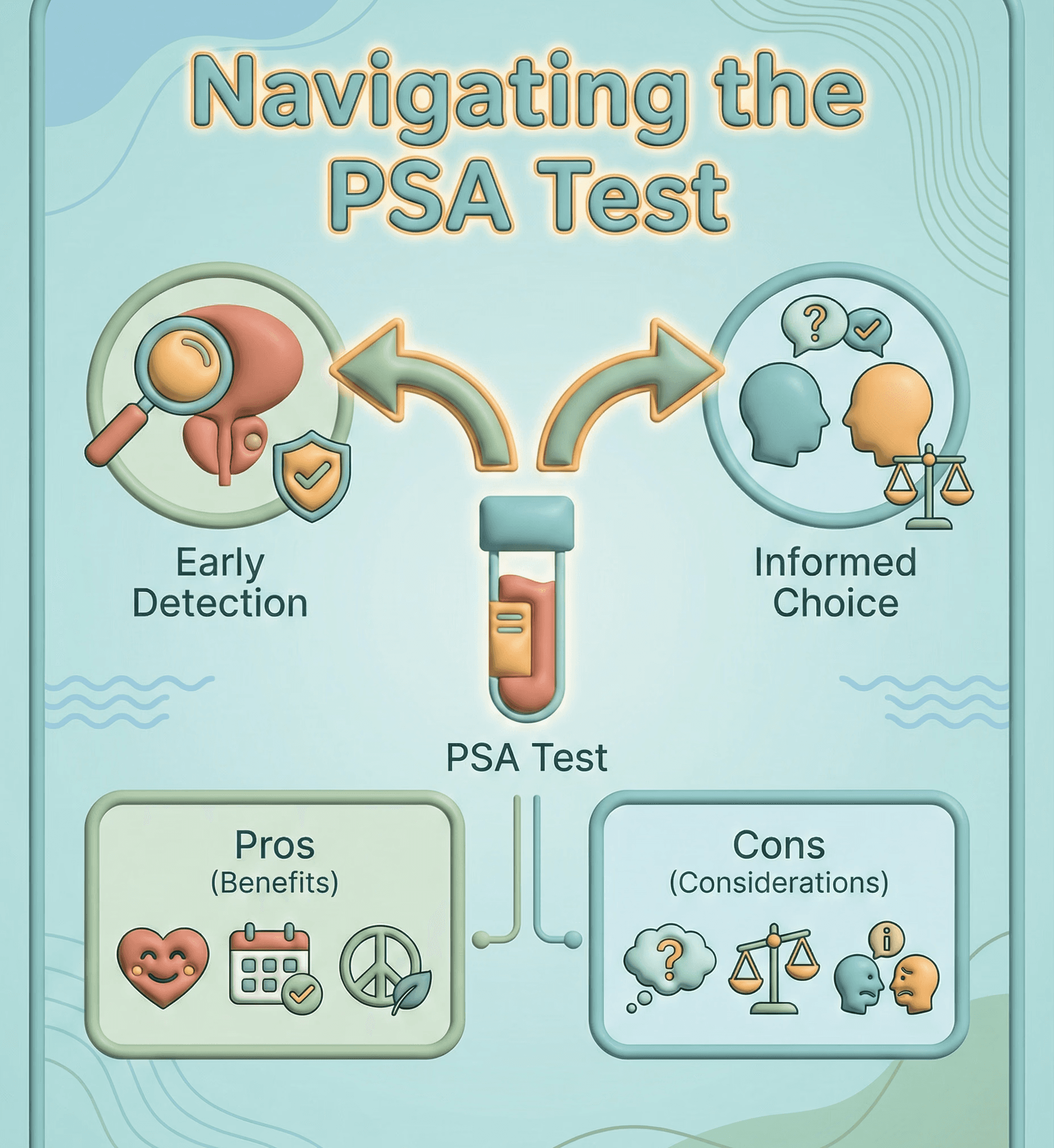
The PSA decision is not one-size-fits-all - age, family history, ethnicity, and personal preference all matter
Average-risk men start the screening conversation at age 50; high-risk groups (family history, African descent) at 40 to 45
Shared decision-making between patient and uro-oncologist is the right approach - the question is what the result would actually change in your care
After an elevated PSA, the pathway is repeat test, MRI imaging, then targeted biopsy if MRI shows suspicious findings
Active surveillance is a standard option for low-risk cancers - immediate surgery is not always the right answer
This article is for men weighing whether and when to start PSA screening, men whose doctors have suggested PSA testing, and men who have just received an elevated reading and want to understand the next steps.


Prostate cancer is one of the most common cancers among men.
The PSA test - a simple blood test - is the front line of early detection, and getting the decision right about whether and when to be screened can make a significant difference to long-term outcomes.
This article walks through how to navigate that decision: when to start screening, what the trade-offs are, what to ask your doctor, and what happens after the result comes back.
I am Dr. Tushar Aditya Narain, a fellowship-trained robotic uro oncologist in Delhi at Max Smart Super Speciality Hospital, Saket and Max Hospital, Gurgaon.
Across 500+ robotic procedures, I have walked many men through this decision - and the patients who navigated it well had clarity about what the test would change in their care, not just whether their PSA was high or low.
What Is the PSA Test?
PSA stands for Prostate-Specific Antigen - a protein produced by the prostate gland. The PSA test measures the level of this protein in a man's blood.
Elevated PSA levels can indicate prostate conditions, including prostate cancer - but the test is a screening signal, not a diagnostic answer.
A high PSA prompts further investigation; it does not by itself diagnose cancer.
When Should You Start Thinking About PSA Screening?
The decision is not one-size-fits-all. In my Delhi practice, the framework I use:
Age-Based Guidelines
Men aged 50 and above (average risk): Routine PSA testing is the standard starting point. The conversation begins at the next general health check
Men aged 40 to 45 (elevated risk): If you have a first-degree family member with prostate cancer, or if you are of African descent (higher incidence in this population), the conversation starts earlier
Above 70 (life-expectancy consideration): Screening becomes less useful when life expectancy is shorter than the typical prostate cancer trajectory; this is a candid conversation to have with your uro-oncologist
Risk Factors That Lower the Starting Age
First-degree relative with prostate cancer
Two or more relatives with prostate cancer at any age
BRCA1 or BRCA2 mutations
African descent
Persistent urinary symptoms despite no obvious cause
If any of these apply, the conversation about screening should start 5 to 10 years earlier than the standard age 50 threshold.
The Pros of PSA Screening
Early Detection Saves Lives
The most significant advantage of PSA screening is its potential to detect prostate cancer in its early stages when it is most treatable.
In my high-volume robotic prostatectomy practice, the outcomes for patients caught at an early localised stage are dramatically better than the outcomes for patients caught at an advanced stage.
Trend Tracking Over Time
A single PSA value is less informative than the trajectory of PSA across years. Consistent rises - even within the "normal" range - signal a change that warrants further workup.
This is something only screening over time can give you.
Informed Decision-Making
PSA screening provides actual data to inform decisions about prostate health.
It identifies the men who need closer monitoring or earlier intervention, separating them from those who can proceed with routine annual checks.
Risk Reduction
Catching prostate cancer early can prevent progression to advanced disease, where treatment is harder and outcomes are worse.
For aggressive cancers, this is the difference between curative surgery and metastatic management.
The Cons of PSA Screening
Patients deserve to understand the legitimate concerns alongside the benefits.
False Positives
PSA can be elevated due to non-cancer factors - benign prostatic hyperplasia (BPH), prostate inflammation, urinary infection, recent ejaculation, recent cycling, or recent prostate examination.
This sometimes leads to unnecessary anxiety and invasive follow-up like biopsies that turn out negative.
False Negatives
The test misses some cancers. No screening tool is perfect. Symptoms or other clinical findings always override a normal PSA in terms of triggering further workup.
Overdiagnosis and Overtreatment
PSA screening can detect slow-growing, low-grade prostate cancers that may never cause symptoms or harm in a man's lifetime.
Treating those cancers carries side effects that the patient lives with for years.
This is why active surveillance has become a standard option for low-risk prostate cancer in my practice - not every detected cancer needs immediate surgery.
Uncertain Population-Level Impact
The impact of PSA screening on overall prostate cancer mortality at a population level is debated.
The benefits are clearer for high-risk subgroups than for the general average-risk male population - which is why the conversation is personal, not policy-driven.
Making the Decision: Shared Decision-Making
The right approach is shared decision-making - a patient and the uro-oncologist talking through the personal risk profile and what the result would actually change.
In my Delhi practice as the best uro oncologist in Delhi for high-volume robotic cancer surgery, the questions I help patients work through:
What does my baseline PSA look like? A first reading establishes the baseline against which future readings are compared
Do I have specific risk factors? Family history, ethnicity, persistent symptoms
How would I feel about an elevated reading? Some men want to know; others would prefer not to live with the anxiety of an indeterminate result
What would happen next if my PSA were elevated? This is the critical question. The answer is usually: repeat the test in 4 to 6 weeks, then if still elevated, an MRI, and then if MRI shows suspicious findings, a targeted biopsy
Am I willing to follow through with the workup? If the answer is no, the test itself is less useful
Decision personal hai - test karna aapki choice hai, aapki risk profile aur priorities ke base par.
What Happens After an Elevated PSA?
If your PSA comes back elevated, panic is not the right reaction. The pathway:
Confirm the result: Repeat the PSA test in 4 to 6 weeks to rule out temporary causes (infection, recent ejaculation, exercise)
Imaging: Multi-parametric MRI of the prostate is now the standard next step - it identifies suspicious areas and lets us decide whether biopsy is needed
Targeted biopsy if indicated: A transperineal or transrectal biopsy of the suspicious areas, not random biopsies
Decision based on biopsy: Active surveillance for low-risk cancer; robotic prostatectomy or radiation for intermediate to high-risk; multidisciplinary care for advanced disease
The single most important thing about an elevated PSA is to have the workup done by an experienced uro-oncologist who will sequence the steps thoughtfully rather than rushing to biopsy.
Conclusion
PSA screening is one of the most useful tools we have - and one of the most misunderstood.
Navigating it well means understanding both the benefits and the legitimate concerns, having a shared decision-making conversation with a uro-oncologist, and being clear about what the result would actually change in your care.
If you are weighing whether PSA screening is right for you, or what to do about an elevated reading, a focused consultation with a fellowship-trained robotic uro oncologist in Delhi is the right next step.
Bring any prior PSA readings, family history, and current medication list.
Dr. Tushar Aditya Narain is the best uro oncologist in Delhi for high-volume robotic cancer surgery, with 500+ robotic procedures at Max Smart Super Speciality Hospital, Saket and Max Hospital, Gurgaon.
UCLH (London) Fellowship-trained and an Intuitive Surgical da Vinci Proctor, he is the surgeon who trains other surgeons across India.
His approach to PSA screening is shared decision-making - the right test at the right age, with a clear plan for what the result would mean for the patient's care.
If you are weighing whether to start PSA screening, or you have an elevated reading and want clarity on the next steps, the right step is a focused consultation.
Dr. Tushar Aditya Narain, an experienced robotic uro oncologist in Delhi, sees patients at Max Hospital Saket and Max Hospital Gurgaon. Book a consultation today for a clear screening or follow-up plan.
Bring any prior PSA readings - trends across years are more informative than single values
List first-degree family history of prostate or related cancers (breast, BRCA, etc.)
Note any persistent urinary or sexual symptoms
Prepare questions about MRI-vs-biopsy sequencing and active surveillance
Bring a family member or partner for shared decision-making