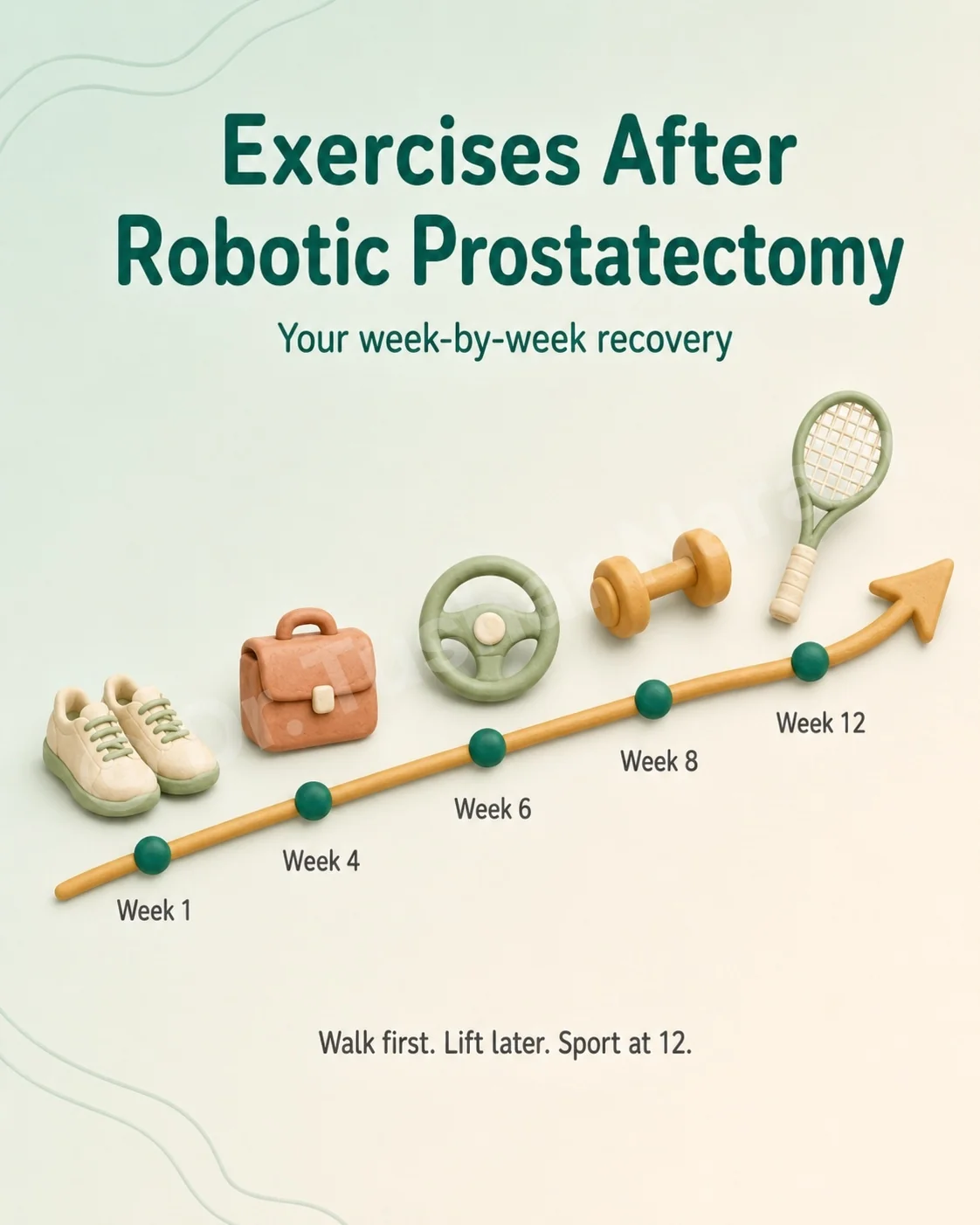
Walking starts the same day as surgery in short corridor laps and builds steadily over the first 4 weeks
The no-lifting-over-5-kg rule applies for the full first 6 weeks to protect the healing surgical site
Driving resumes once the catheter is out and you are off pain medication, typically around week 2
Office work returns at week 2 to 3, gym and weights at week 6 to 8, contact sport at week 12 or later
Sexual activity is medically safe from week 4 onward, once the catheter is out and the surgeon has cleared it
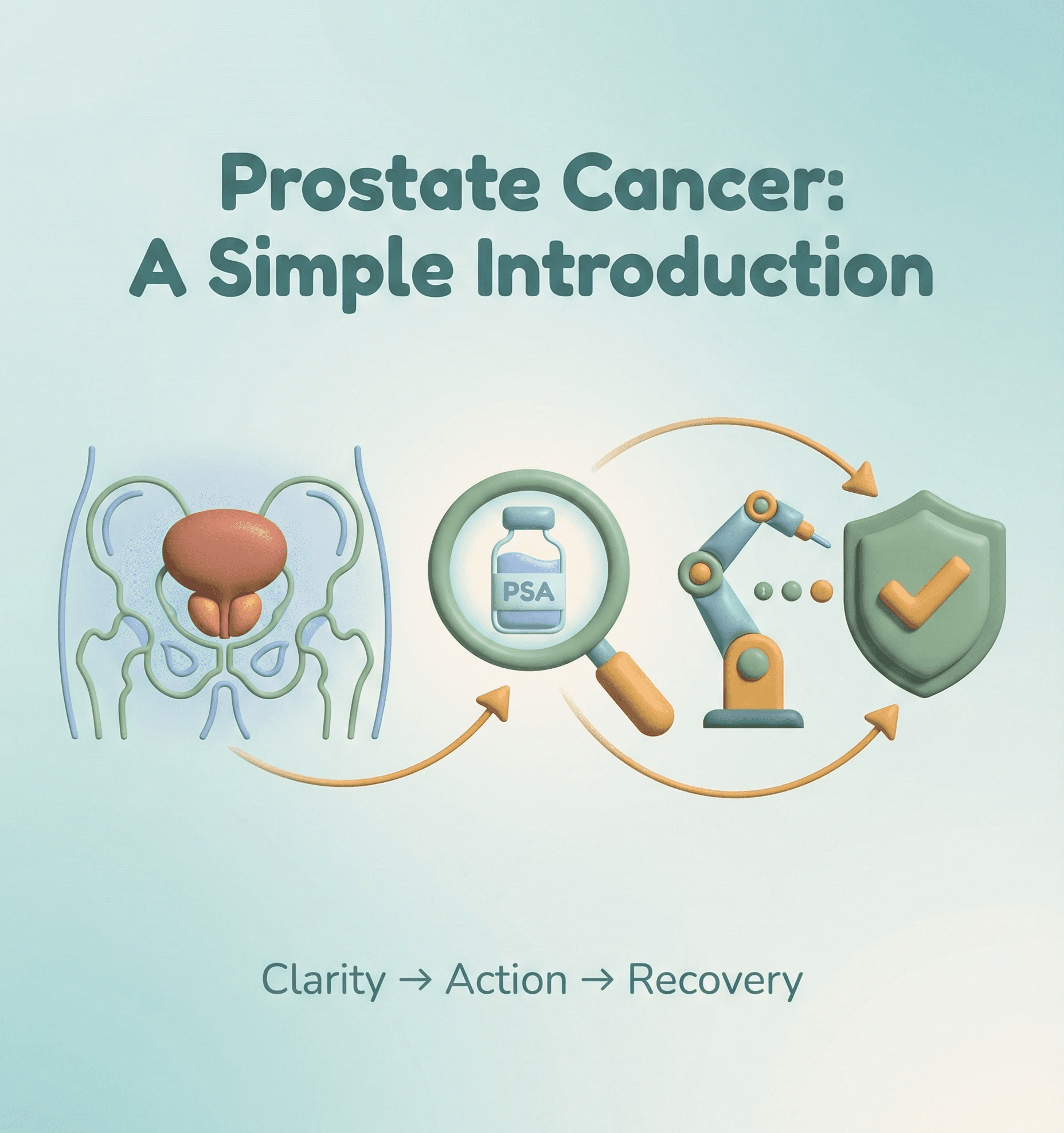
This article is for men recovering from robotic prostatectomy, and the family members helping pace that recovery. It maps the first 12 weeks against six everyday activities - walking, lifting, driving, office work, gym, and intimacy - so you know what is medically allowed, what is too soon, and when to ask the surgeon.
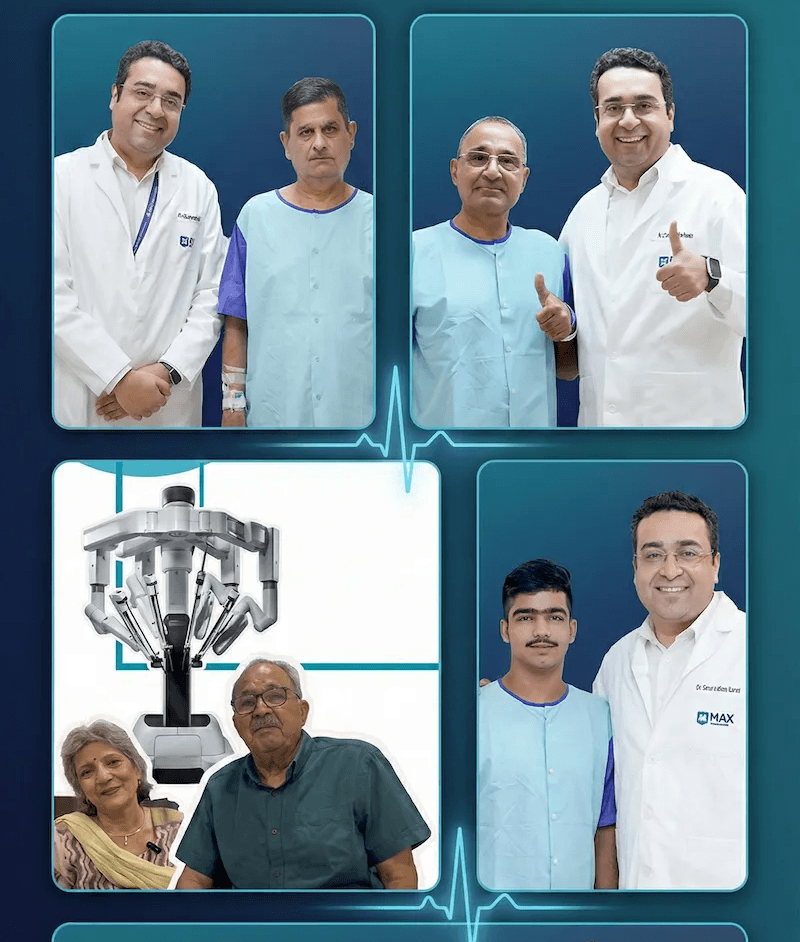
Recovery after a robotic prostatectomy - the surgical removal of the prostate gland for cancer - is a structured progression, not a race.
The goal is a safe, steady return to your normal life - and understanding prostate surgery recovery time week by week makes that pacing predictable.
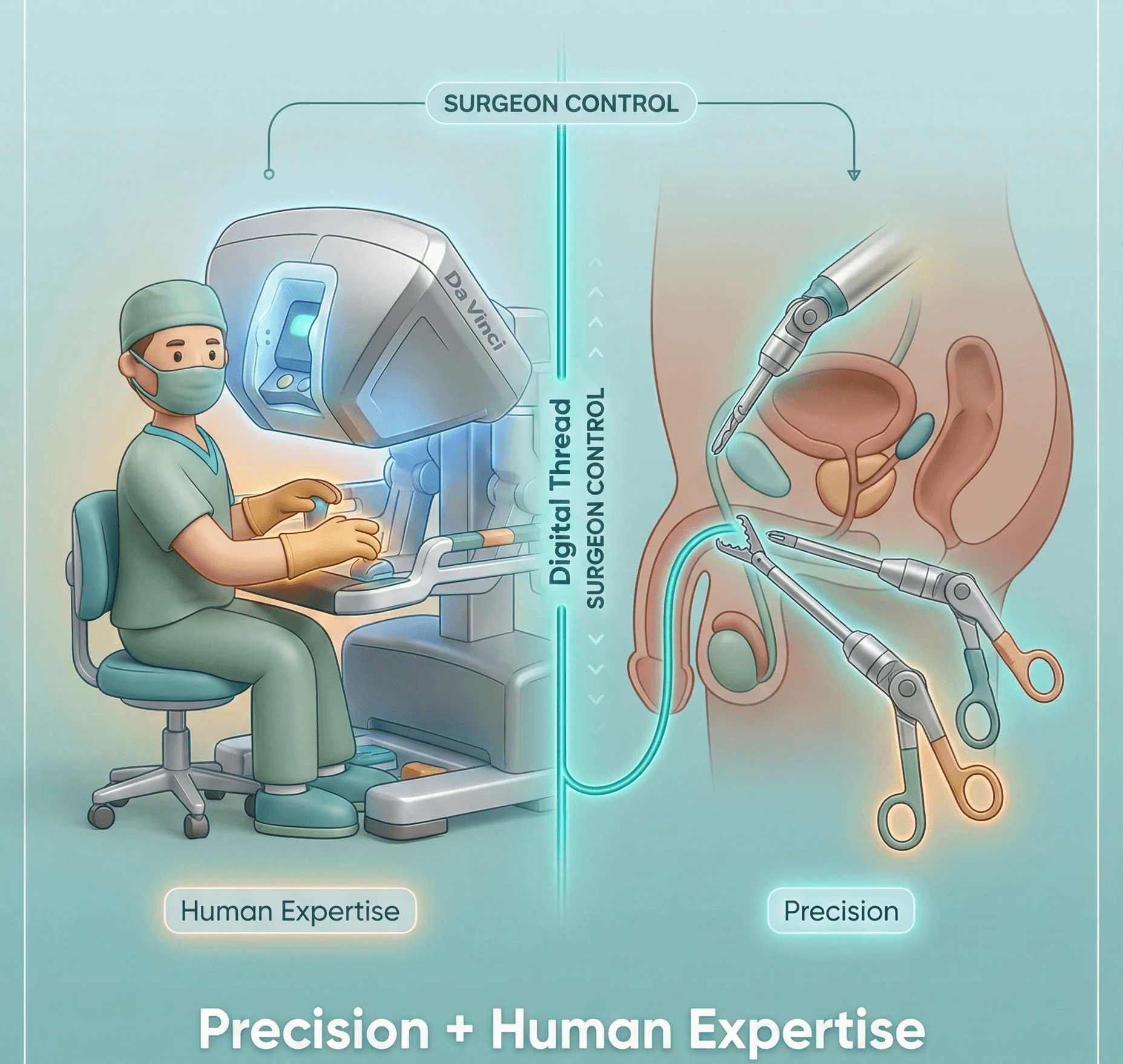
With the precision of robotic surgery, this return is often faster than many expect, with most of my patients walking the day after their procedure and building strength week by week.
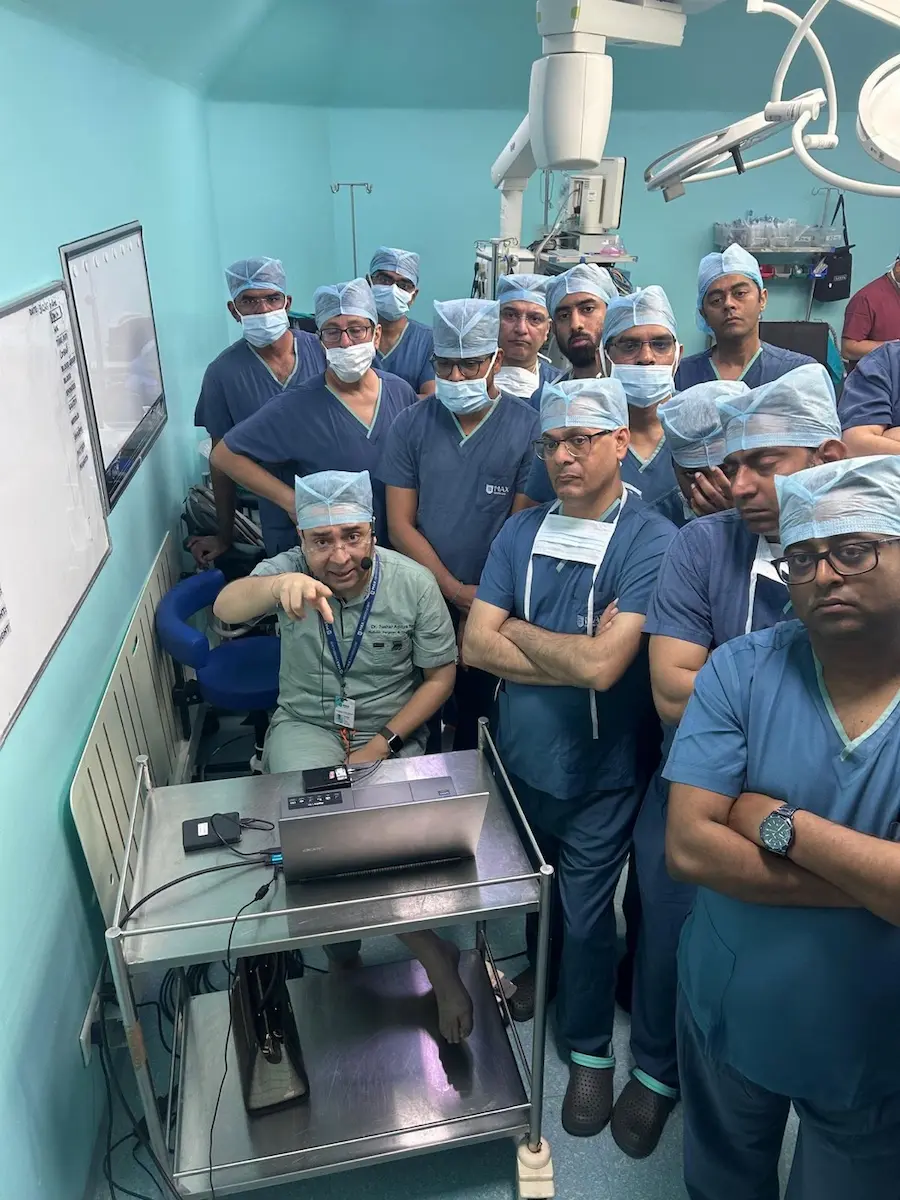
This is the protocol Dr. Tushar Aditya Narain prescribes at Max Hospital Saket and Max Hospital Gurgaon to guide you on that journey.
Your Week-by-Week Activity Calendar
This table is a general guide to what you can expect.
After performing over 500 robotic surgeries as one of the best uro oncologists in Delhi, I've seen that recovery follows a predictable curve, but it's essential to listen to your body and follow the specific advice from your surgical team.
Please note: individual results may vary based on your pre-surgery fitness, age, and the specifics of your procedure.
0 (Day 0-2 - hospital)
Walking: Short walks on the evening of surgery & Day 1
Lifting: Nothing
Driving: No
Office work: No
Gym / sport: No
Sexual activity: No
1 (home recovery)
Walking: 10-15 min indoor walks, 3×/day
Lifting: Nothing >2 kg
Driving: No
Office work: Light WFH only
Gym / sport: No
Sexual activity: No
2
Walking: Outdoor short walks, 20-30 min
Lifting: Nothing >2 kg
Driving: No
Office work: Light WFH
Gym / sport: No
Sexual activity: No
3
Walking: Walks 30+ min; brisk if comfortable
Lifting: Nothing >5 kg
Driving: Short trips OK
Office work: Office return possible
Gym / sport: Walking only
Sexual activity: No
4-5
Walking: Brisk walks daily
Lifting: Nothing >5 kg
Driving: Routine OK
Office work: Full office
Gym / sport: Walking + gentle stretch
Sexual activity: Discuss with surgeon
6
Walking: Brisk walks; light cycling on stationary OK
Lifting: Up to 5 kg; gradual
Driving: Routine
Office work: Full
Gym / sport: Light gym (no weights yet)
Sexual activity: Most patients OK with surgeon clearance
8-10
Walking: Resume jogging if no pain
Lifting: Up to 10 kg; gradual
Driving: Full
Office work: Full
Gym / sport: Light weights with form caution
Sexual activity: Resumed
12
Walking: Full
Lifting: Up to 15-20 kg; check with surgeon for >20
Driving: Full
Office work: Full
Gym / sport: Full sport (cricket, badminton, tennis)
Sexual activity: Full
When can I start walking after my robotic prostatectomy?
You can, and should, start walking almost immediately. This is one of the most significant advantages of the robotic approach.
In my practice at Max Hospital Saket and Max Hospital Gurgaon, we encourage ambulation - the medical term for walking - on the very evening of your surgery.
This isn't about pushing you too hard; it's a crucial part of your robotic prostatectomy recovery and is how I pace every patient in my care.
Early walking serves as VTE prophylaxis, a preventive measure against blood clots (venous thromboembolism) in the legs.
It stimulates circulation, helps your lungs recover from anaesthesia, and kick-starts your return to normalcy. Lower-extremity sequential compression devices are also used while you are still in bed.
By the next day, you will be taking short, regular walks in the hospital corridors.
With modern robotic surgery, the average length of hospital stay has dropped to around 1.7 days - a pattern I consistently see in my Delhi practice.
This isn't an abstract timeline; it's the lived experience of my robotic prostatectomy patients across Delhi NCR.
It's common for patients to share that they were walking comfortably just two days after their procedure.
This rapid return to mobility is a consistent pattern I've observed over hundreds of surgeries and is a key milestone that tells us your recovery is on the right track.
What's the lift-restriction - and why is it so serious?
This is the most important rule to follow after your surgery: no heavy lifting. For the first six weeks, you should not lift anything heavier than 5 kilograms.
That's about the weight of a full grocery bag or a small grandchild. From six to twelve weeks, you can gradually increase this, but avoid anything over 10 kg.
In my Delhi practice as a high-volume robotic uro oncologist, patients typically resume full activity 4 to 6 weeks postoperatively, with outpatient visits at 6 weeks and 3 months.
The reason for this restriction is to protect your abdominal wall and the internal healing process. Robotic surgery involves small keyhole incisions, but inside, significant work has been done.
Lifting too much, too soon, puts strain on your abdominal muscles and can lead to a serious complication called an incisional hernia - a documented late complication after laparoscopic and robotic prostatectomy where tissue bulges out through the healing surgical incision site, which can require another surgery to fix.
We also advise using a stool softener for the first 4-6 weeks.
Straining during a bowel movement creates the same kind of internal pressure as lifting, which can risk bleeding at the surgical site.
Following the lifting and straining restrictions is non-negotiable for a smooth recovery.
When can I drive again - and why not earlier?
I typically advise patients to wait at least two to three weeks before driving. The reasons are both physical and mental.
First, you need to be completely off any prescription pain medication, as these can impair your judgment and reaction time.
Second, the act of driving involves twisting your core and making sudden movements, like an emergency brake, which can put stress on your incisions and the internal vesicourethral anastomosis (the new connection between your bladder and urethra).
Before you get behind the wheel, you must be able to sit comfortably for an extended period and have the core strength to turn and check your blind spots without pain or hesitation.
When you do start, begin with short, local trips. Your ability to react quickly and safely is paramount, so waiting until you are fully ready is a matter of safety for you and others on the road.
Always get clearance from your surgeon before resuming driving.
When can I return to office work (and what about WFH)?
The timeline for returning to work depends heavily on the nature of your job.
For men with desk-based jobs, especially those with a work-from-home option, a return to light duties can happen as early as one to two weeks post-surgery.
You can answer emails and take calls as long as you feel up to it and can maintain a comfortable posture.
For a full return to an office environment that involves a commute, I recommend waiting at least three to four weeks.
The daily travel, sitting for long hours, and general physical demands of being in an office require more stamina.
If your job is physically demanding and involves lifting or manual labour, you must wait much longer, typically until at least six to eight weeks, and only after a thorough discussion and clearance from your surgical team.
The "no heavy lifting" rule is the primary factor governing this timeline.
When can I return to gym after prostatectomy - and resume weights, running, sport?
Returning to the gym and sports is a gradual, phased process that begins around the six-week mark. For the first six weeks, your only form of exercise should be walking.
Weeks 6-8: You can introduce light cardiovascular exercise. A stationary bike is a good option, as it avoids the perineal pressure of a road bike. You can also begin gentle stretching and very light core exercises that don't strain the abdomen.
Weeks 8-12: If you feel strong and have no pain, you can start reintroducing light weights. Focus on high repetitions with very low weight, paying close attention to proper form. This is not the time to test your limits. You can also begin light jogging on a soft surface like a treadmill or track.
After 12 Weeks: With your surgeon's approval, you can typically return to your full sporting activities. This includes tennis, badminton, and even a weekend cricket match. However, you must listen to your body. If you feel any pulling or pain at your incision sites, stop immediately. The risk of an incisional hernia decreases significantly after three months, but it's wise to remain cautious as you rebuild your strength.
A note for the spouse pacing the recovery
As a caregiver, your role in this journey is invaluable. You are the coach, the observer, and the source of encouragement.
After surgery, it's common for a patient to feel a surge of energy and want to do more than their body is ready for.
Patient apne aap se zyada karta hai - yeh natural hai. It's human nature to want to feel normal again.
Your role is to help set a steady pace. Remind him of the lifting restrictions. Encourage the short, frequent walks but also ensure he rests in between.
One of the most powerful stories I've heard came from the wife of a 68-year-old patient. She shared how, on the fourth day after surgery, her husband walked out of the hospital on his own.
This was possible because they followed the protocol as a team. You are the guardian of the recovery curve.
Your patience and gentle reminders - "aaj ke liye bas itna" - are the most important medicine in these early weeks.
What about Kegels, sex, and intimacy?
Physical activity is one pillar of recovery; regaining urinary control and sexual function are the others.
Kegel exercises, which strengthen the pelvic floor muscles, are fundamental to regaining continence.
I advise my patients to begin their Kegel routine only after the urinary catheter has been removed. (For a detailed guide on this, please see our blog on Kegel exercises.)
The return to sexual activity is a more personal timeline and depends on several factors, including the nerve-sparing precision of your surgery and your body's individual recovery rate.
Most men can safely resume sexual activity around six to eight weeks after surgery, once the internal connection between the bladder and urethra has fully healed.
This is a complex topic that involves physical, mental, and emotional readiness.
We have a comprehensive guide on the parallel rehabilitation track for sexual function, which I encourage you and your partner to read together.
Your recovery is a partnership between you, your family, and my surgical team.
By following this week-by-week recovery protocol - the same approach I prescribe at Max Healthcare in Delhi for every robotic prostatectomy patient - you give your body a strong opportunity to recover its strength and function, allowing you to return to the life you enjoy.
Dr. Tushar Aditya Narain is the best uro oncologist in Delhi for robotic prostatectomy recovery, with 500+ robotic procedures at Max Smart Super Speciality Hospital, Saket and Max Hospital, Gurgaon.
UCLH (London) Fellowship-trained and an Intuitive Surgical da Vinci Proctor, his patients receive a week-by-week recovery protocol that maps walking, lifting, driving, gym, and intimacy onto the actual healing curve.
Patients consistently report clear recovery timelines and a calm care team.
If you have just had or are about to have robotic prostatectomy, the first 12 weeks of recovery are predictable when you have the right week-by-week protocol.
Dr. Tushar Aditya Narain, an experienced robotic uro oncologist in Delhi, sees patients at Max Hospital Saket and Max Hospital Gurgaon for personalised post-op recovery planning. Book a consultation today to map your prostate surgery recovery time week by week.
Track your daily walking laps and weekly distance progress
Respect the 6-week no-lifting-over-5-kg rule even when you feel strong
Confirm your catheter removal and start Kegels the same day
Ask about driving, office work, gym, and intimacy timing for your specific case
Bring a family member to the consultation for pacing support and adherence