Best urologist in Delhi means different things depending on your specific need - sub-specialisation is the single biggest differentiator
Five markers separate top urologists - deep focus, fellowship training at high-volume international centres, robotic case volume, peer-validated proctor status, multidisciplinary team support
Modern urology is not one specialty - it is several; the strongest urologists have gone deep on one slice rather than broad across all
Dr. Tushar Narain - UK and US fellowships, AIIMS Delhi + PGIMER Chandigarh foundation, two Intuitive Surgical Proctor designations, 500+ robotic procedures
First Indian surgeon trained in Single Port Robotic Surgery at Cleveland Clinic, USA - a credential few urologists in Delhi or India hold
This article is for patients and families across Delhi-NCR weighing a urological consultation - particularly for cancer or complex robotic surgery cases - who want a structured framework for choosing the right specialist before committing.
The word "best" gets thrown around so often in healthcare that it loses meaning.
For a patient sitting across a urologist for the first time - anxious, often with a family member in tow, weighing a decision that could shape the next decade of their life - the question is not about superlatives.
It is about specifics. What credentials should the patient look for? What case volume? What focused expertise?
What does "best urologist in Delhi" actually mean in practical terms when you are the one making the choice?
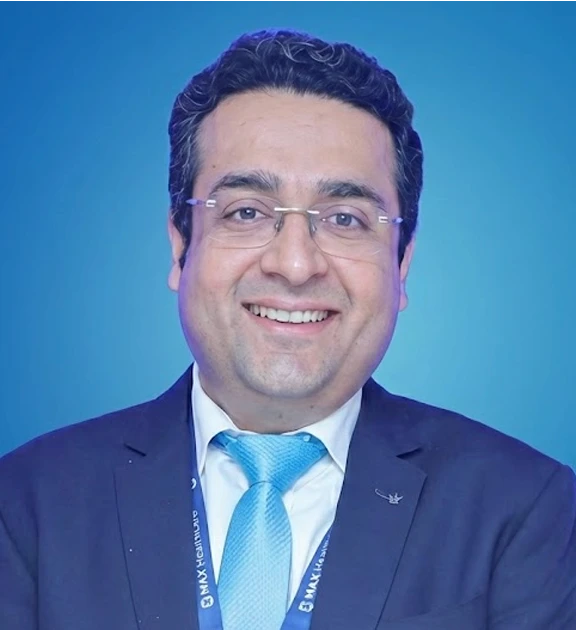
I am Dr. Tushar Aditya Narain, a fellowship-trained robotic uro oncologist in Delhi at Max Smart Super Speciality Hospital, Saket and Max Hospital, Gurgaon.
Across 500+ robotic procedures, I have sat on both sides of this question - as the surgeon being chosen by patients, and as a clinician who watches families work through the decision.
This article walks through what genuinely separates strong urologists from average ones, applies that framework to my own practice, and gives patients and families a concrete way to evaluate the choice in front of them.
The "Best Urologist" Question - What Actually Separates Great from Average
Urology in modern practice is not one specialty. It is several.
The urologist who routinely manages stones, BPH, and incontinence operates in a different clinical universe from the uro-oncologist managing complex robotic prostatectomies and cystectomies.
The urologist who specialises in male infertility looks nothing like the one focused on neuro-urology and reconstructive surgery.
The "top urologist" question therefore depends on which slice of urology the patient actually needs - and the strongest urologists are the ones who have gone deep into one slice rather than staying broad across all.
For patients across Delhi-NCR weighing this choice, the practical question becomes: how do you evaluate a urologist's expertise before committing?
Five markers consistently separate strong urologists from the rest.
The 5 Markers of a Top Urologist
1. Sub-Specialisation, Not Generalism
The biggest single differentiator.
A urologist who handles kidney stones in the morning, BPH in the afternoon, and prostate cancer in the evening is technically broad - but rarely deep on any one of those.
The urologists who deliver consistently strong outcomes are the ones who have concentrated their practice on a specific subset of urology: uro-oncology, endourology, female urology, pediatric urology, or reconstructive urology.
For complex cases especially, focused expertise is the single most reliable signal of competence.
2. Fellowship Training at a High-Volume International Centre
Fellowship is where surgical technique gets refined past competence into mastery.
The most respected urological fellowships globally - based in London, the USA, Memorial Sloan Kettering, MD Anderson, and select European centres - give surgeons exposure to high-volume complex caseloads under strict evidence-based protocols.
International fellowship training, paired with strong Indian academic foundations, is a verifiable credential that the strongest urologists in Delhi will have done.
Ask directly: where did you train internationally, and for how long?
3. High-Volume Robotic Practice
For urological cancers and complex reconstructive cases, robotic surgery has become the modern standard at top centres.
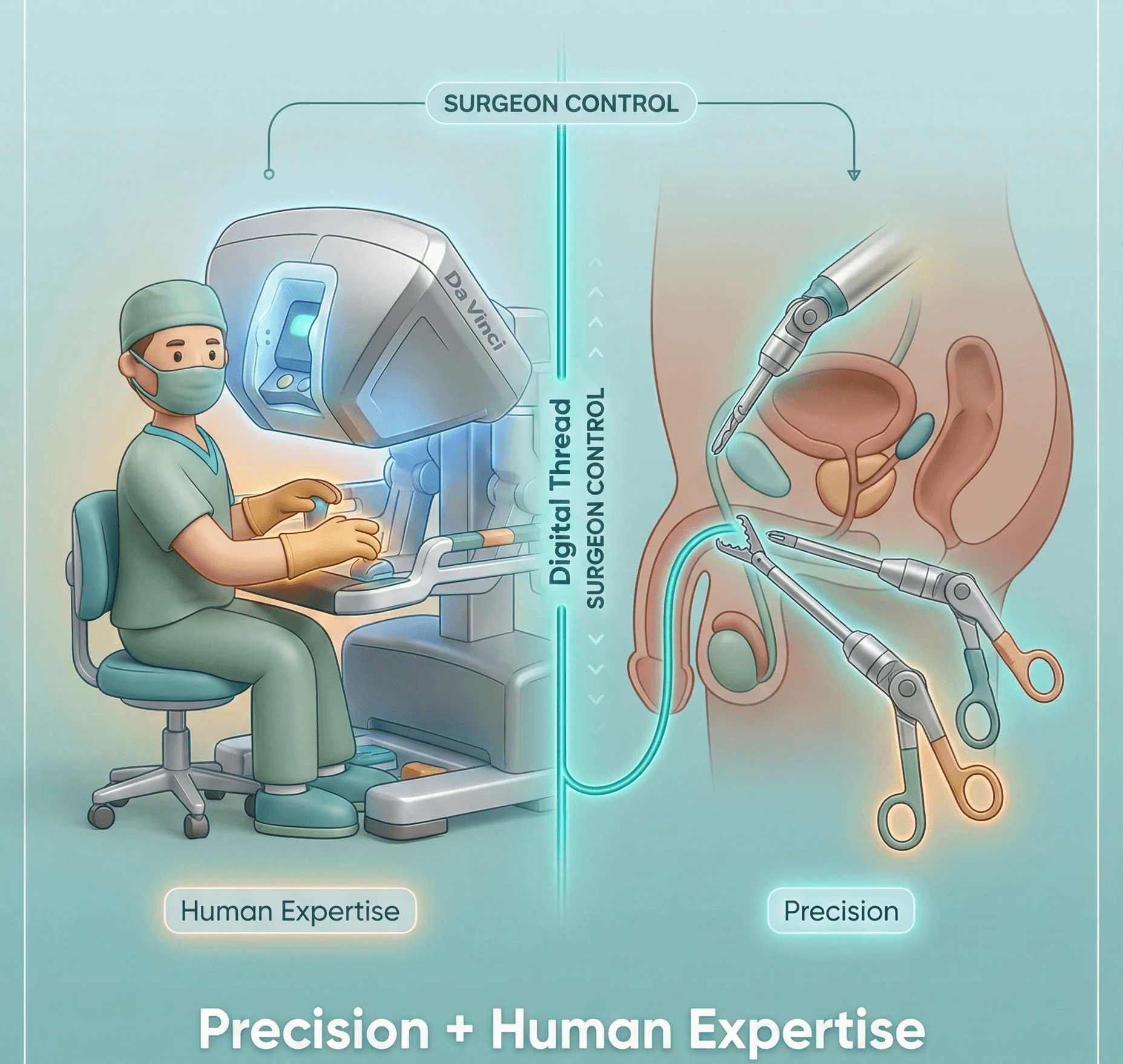
The robot itself is just a precision platform - the outcomes come from the surgeon's case volume on it.
Surgeons who have personally performed hundreds of robotic procedures bring a fluency on the platform that surgeons with dozens cannot match.
Specific volumes matter: not just "I do robotic surgery" but "how many robotic prostatectomies have you done in the last year specifically?"
4. Peer Recognition Through Proctor Status
The strongest signal of surgical mastery is being trusted to teach other surgeons.
Intuitive Surgical (the company that makes the Da Vinci system) designates select urologists as Proctors - surgeons whose technique meets the standard required to train other practising urologists on the platform.
Proctor status is procedure-specific and peer-validated; it is not a self-claim. For a patient evaluating their surgeon, proctor status is one of the cleanest objective signals available.
5. Multidisciplinary Team and Communication
Technical credentials matter but they are not sufficient.
A patient walking into a urological consultation - particularly for cancer - needs a surgeon who can explain the diagnosis calmly, lay out options honestly, walk through trade-offs without rushing, and operate within a multidisciplinary team that handles every step from diagnosis through long-term follow-up.
Pehli consultation mein clarity milti hai ya nahi - yeh aap turant samjh jaate ho. Decision ke liye yeh sab se important signal hai.
Why Focused Expertise Matters More in Urology Than Most Specialties
Urology is unusual because the same body system covers a wide range of clinical problems that share anatomy but require very different surgical mindsets.
The pelvic floor, the kidneys, the urinary tract, and the reproductive system all sit under "urology" - but managing a kidney stone is a fundamentally different problem from preserving urinary continence after prostatectomy.
The skills, instincts, and operative volumes that build one expertise do not transfer cleanly to the other.
This is why the best urologists in Delhi today are not the most generalist ones - they are the most sub-specialised.
A patient with prostate cancer needs a uro-oncologist who has done the specific cancer surgery many times, not a generalist who occasionally handles cancer cases between stone procedures.
The patterns of nerve-sparing precision, surgical margin clearance, and post-surgery continence recovery are the dividend of focused volume, not breadth.
The corollary: when patients evaluate the right urologist for their case, the filter is matching the patient's specific need against the urologist's specific focus.
A urologist with deep stone-management expertise is the right answer for a stone problem; a uro-oncologist with high robotic volume is the right answer for cancer.
Best is always best-for-this-specific-need.
Dr. Tushar Aditya Narain - The Markers Applied in Practice
Patients ask why they should consider my practice as the right urologist for their case. The honest answer is to apply the five markers above and let them guide the comparison.
Sub-Specialised in Robotic Uro-Oncology
My practice is focused on robotic surgery for urological cancers - prostate cancer, kidney cancer, bladder cancer, testicular and penile cancers, adrenal masses, and complex reconstructive cases.
I do not split attention across stones and BPH and male infertility and general urology.
The volume and consistency this builds across cancer cases is what delivers the outcomes I see in my Delhi practice.
Fellowship Training at Two of the World's Leading Robotic Urology Centres
My international training spans two distinct fellowships:
Two-year Fellowship in Robotic Pelvic Uro-Oncology at University College London Hospital (UCLH), UK - one of the UK's highest-volume centres for robotic urological cancer surgery. The London fellowship managed a complex caseload under strict evidence-based protocols, and the technique I bring to every case is calibrated against that benchmark.
First Indian surgeon trained in Single Port Robotic Surgery at Cleveland Clinic, USA. Single Port is the next-generation robotic platform, and being the first Indian surgeon trained on it at this American institution is a credential that few urologists in Delhi or India hold.
This is paired with the strongest Indian urology training pathway available - MCh at AIIMS Delhi and MS at PGIMER Chandigarh, the two institutions that produce most of India's senior uro-oncologists.
High-Volume Robotic Practice - 500+ Procedures and Counting
Across Max Saket and Max Hospital, Gurgaon, my practice has crossed hundreds of robotic procedures.
Within that volume, the case mix spans robotic radical prostatectomy with nerve-sparing, robotic partial and radical nephrectomy with kidney preservation as default, robotic radical cystectomy with intracorporeal neobladder reconstruction, and complex reconstructive work.
High volume across multiple cancer types - not single-procedure depth alone - is the foundation of consistent outcomes.
Peer-Validated Through Multiple Proctor Designations
I hold two distinct Intuitive Surgical Proctor designations:
General Da Vinci Proctor - authorised to train other practising urologists across India on robotic urological surgery technique
Intuitive Surgical Proctor for Radical Cystectomy specifically - a procedure-specific proctorship for one of the most technically demanding robotic urological operations
Proctor designations are peer-validated by the manufacturer of the Da Vinci system based on surgical technique, case volume, and outcomes.
They are publicly verifiable credentials - not marketing claims.
Mentorship From the Global Pioneers of Robotic Urology
Beyond fellowships, my training included direct mentorship from senior consultants who are among the most respected names in robotic urology globally - surgeons who themselves pioneered the techniques I now use daily.
Peer mentorship at this level is the academic genealogy that shapes a surgeon's standards for decades.
Conditions and Procedures Within My Practice Scope
For patients evaluating the right urologist for their specific case, my focused scope covers the following urological cancers and related conditions:
Prostate Cancer
Robotic radical prostatectomy with nerve-sparing
Bladder-neck preservation technique for optimal continence recovery
Penile rehabilitation pathway support post-surgery
Multi-parametric MRI-targeted prostate biopsy
Active surveillance protocols for low-risk cases
Kidney Cancer
Robotic partial nephrectomy for T1 tumours (kidney preservation as the default)
Robotic radical nephrectomy for larger or anatomically complex tumours
Robotic nephro-ureterectomy for upper tract urothelial cancers
Complex cases including hilar and endophytic tumours
Bladder Cancer
Robotic radical cystectomy with intracorporeal urinary diversion
Neobladder reconstruction (orthotopic) or ileal conduit, decided per case
Endoscopic resection (TURBT) and intravesical therapy for non-muscle-invasive disease
Surveillance cystoscopy and follow-up protocols
Other Urological Cancers
Testicular cancer with retroperitoneal lymph node dissection where indicated
Penile cancer with sentinel node biopsy
Adrenal cancer with robotic adrenalectomy
Complex reconstructive urological surgery
Multidisciplinary Care at Max Healthcare
My practice operates within the Max Healthcare team - medical oncology for cases needing systemic therapy, radiology for staging and surveillance imaging, pathology for accurate grading, and dedicated rehabilitation support.
Mr. Manpreet Singh, Mr. Praveen Rathi, and Mr. Manish Sharma coordinate the patient pathway from first consultation through long-term follow-up.
What Patients Across Delhi-NCR Consistently Mention
Across the cancer cases I have handled at Max Saket and Max Hospital, Gurgaon, the themes that come up consistently in patient feedback:
Clear communication that turns anxiety into understanding. Patients consistently mention that the first consultation explained the diagnosis, the options, and the recovery realities in plain language rather than medical jargon
Recovery faster than expected. Hospital stays of 1 to 3 days for most procedures, with patients walking the same day post-operatively and returning to desk work within 1 to 2 weeks
Preserved function alongside cancer control. Continence recovery and sexual function preservation post-prostatectomy, kidney function preservation post-nephrectomy - patients consistently mention how much of their pre-surgery life they were able to keep
Coordinator continuity. A single point of contact through every phase, from admission paperwork through surveillance scheduling, makes the journey manageable
These are aggregated themes from real patient experiences, not individual patient stories.
Each urological cancer journey is unique, but the patterns across a focused high-volume practice are remarkably consistent when the surgical approach and team coordination are right.
Making the Choice - A Concrete Next Step
The search for the best urologist in Delhi is ultimately a personal decision but it does not have to be an overwhelming one. Apply the five markers.
Match the urologist's specific focus against your specific need. Ask the direct questions about case volume, fellowship training, and proctor status.
Trust your read on communication clarity in the first consultation. Sahi specialist ka decision pehle se clear ho jaaye toh treatment journey itni mushkil nahi lagti.
If you or a family member is weighing options for a urological condition - particularly a cancer diagnosis or a complex robotic surgery case - the right next step is a focused consultation.
For urological cancers across Delhi-NCR, my practice at Max Saket and Max Hospital, Gurgaon offers comprehensive care from first consultation through robotic surgery and long-term follow-up.
The combination of UK + USA fellowship training, AIIMS + PGI academic foundation, two Da Vinci Proctor designations, and a high-volume robotic case load is calibrated to give patients the best chance at cancer-free life with preserved function and dignity.
For patients whose primary need falls outside uro-oncology - kidney stones, BPH, urinary tract infections, infertility - the same five-marker framework applies: look for sub-specialised urologists in those areas at Max Healthcare or other top Delhi hospitals.
Dr. Tushar Narain is one of the best uro oncologists in Delhi for high-volume robotic cancer surgery, with 500+ robotic procedures at Max Smart Super Speciality Hospital, Saket and Max Hospital, Gurgaon.
His credential set spans a two-year Fellowship in Robotic Pelvic Uro-Oncology at University College London Hospital (UCLH), the distinction of being the First Indian surgeon trained in Single Port Robotic Surgery at Cleveland Clinic USA, MCh at AIIMS Delhi, and MS at PGIMER Chandigarh - paired with two Intuitive Surgical Proctor designations (general da Vinci and procedure-specific for Radical Cystectomy).
Multidisciplinary support from Mr. Manpreet Singh, Mr. Praveen Rathi, and Mr. Manish Sharma drives the continuity of care patients consistently mention from first consultation through long-term follow-up.
If you are weighing options for a urological condition - particularly a cancer diagnosis, complex robotic surgery case, or second-opinion review - the right next step is a focused consultation.
Dr. Tushar sees patients at Max Hospital Saket and Max Hospital Gurgaon for robotic uro-oncology cases across prostate, kidney, bladder, testicular, penile, and adrenal cancers. Book a consultation today to map your treatment pathway with clarity.
Bring all diagnostic reports - PSA, imaging (CT, MRI, PSMA PET-CT), biopsy/pathology, prior surgical notes if any
Note your specific condition and any prior treatment
Prepare questions about the robotic surgical option and recovery for your case
Bring a family member or partner for shared decision-making
For non-cancer urology needs (stones, BPH, infertility), ask the consultation team for a referral to the right sub-specialist at Max Healthcare